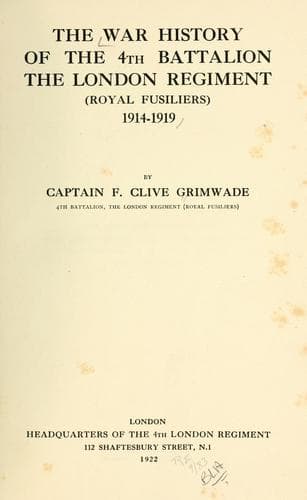
The War History of the 4th Battalion, the London Regiment (Royal Fusiliers), 1914-1919Grimwade, F. Clive
History
The War History of the 4th Battalion, the London Regiment (Royal Fusiliers), 1914-1919
Grimwade, F. Clive
Great Britain. Army. London Regiment. 4th (City of London) Battalion; World War, 1914-1918 -- Regimental histories -- Great Britain
The supplies of webbing equipment having proved inadequate, the troops
were now being provided with leather equipment of the 1915 pattern; and
were armed with the long pattern charger-loading Lee-Enfield rifle. At
this date the training of recruits proceeded under no efficient system
such as was evolved at a later date. No set period was allowed for
the preparation of the drafts, and very few facilities were provided
for improving or speeding-up training beyond such as emanated from
the brains of the officers and N.C.O.'s immediately concerned, with
the inevitable result that a good deal of unnecessary delay and a
certain lack of uniformity in the training ensued. Thanks, however, to
the devoted efforts of the instructors, the recruits soon passed the
initial stages and were passed as "trained" men on a syllabus which
included drill, musketry, marching, physical training and bayonet
fighting, entrenching, field work and the rudiments of bomb-throwing.
The first draft of N.C.O.'s and men supplied by the Battalion
consisting of 40 other ranks under Lieut. N. L. Thomas and 2/Lieuts. S.
Davis, J. W. Price and C. S. G. Blows proceeded to the Dardanelles to
join the 2/4th Battalion at the beginning of November 1915.
Recruiting had continued at a great speed during the months of
July, August and September, and the training companies had assumed
such unmanageable proportions that they were subdivided and a new
training company, C, under Major H. J. Duncan-Teape, was formed, the
Expeditionary Company being renamed D.
On the 29th August 1915 the Battalion was visited by the following
ex-officers of the Regiment:
Lieut.-Col. E. T. Rodney Wilde, V.D.
Lieut.-Col. Harry Dade, V.D.
Lieut.-Col. A. H. Lock, V.D.
Major P. Lynch, and
Major W. Stevens.
On this occasion Church Parade was held at Folly Farm, after which
the Battalion marched past the ex-officers, the salute being taken by
Lieut.-Col. Dade.
On the 13th November an inter-company relief took place, A Company
moving to Beech Hill, and its billets at Littlegrove being occupied by
B Company.
At Christmas 48 hours' leave was granted to every member of the
Battalion, two leave parties being formed for the purpose.
During this period the Reserve Battalions of the 1st London Division
were stationed in all parts of the Home Counties, and the supervision
of training by those responsible was naturally extremely difficult; and
it was consequently decided to bring together all these battalions into
one Divisional camp, the site selected being near Salisbury Plain.
The move to Salisbury took place in January 1916, the 4/4th Battalion
proceeding on the 11th to No. 7 Camp, Hurdcott (between Salisbury and
Shaftesbury), where it found itself for the first time in company with
the 4/1st, 4/2nd, and 4/3rd Battalions, the remainder of the Division
being quartered at Hurdcott and Fovant.
Public-domain text, read in full here on John Shaqi.
Reviews
Reviews
No reviews yet
Be the first to share your thoughts on this work.
Elsewhere in the archive
Join the Discussion
Join the discussion
Sign in to leave a comment or review.
Sign InorCreate an account