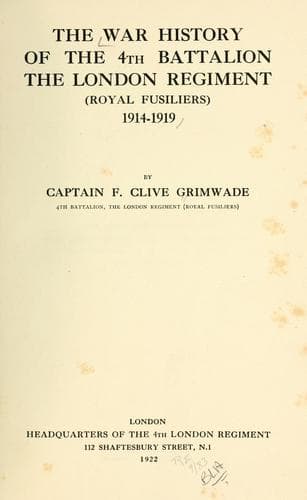
The War History of the 4th Battalion, the London Regiment (Royal Fusiliers), 1914-1919Grimwade, F. Clive
History
The War History of the 4th Battalion, the London Regiment (Royal Fusiliers), 1914-1919
Grimwade, F. Clive
Great Britain. Army. London Regiment. 4th (City of London) Battalion; World War, 1914-1918 -- Regimental histories -- Great Britain
No troops of the 4th London Regiment were after this date quartered at
Barnet, but before finally saying farewell to this the first station
of so many hundreds of the members of the Regiment, we must once more
express the indebtedness of the Regiment not only to those gentlemen
who so generously afforded the Battalion the use of such excellent
training grounds, but also to Mr Kingwell and Mr W. H. Vernon, the
owners respectively of Beech Hill and Littlegrove, for the pains taken
by them to render these houses comfortable for the troops, and to
the many local residents who extended kindness and hospitality to the
Battalion, among whom Mr Eldred of Cockfosters must not be forgotten.
About this time the designation of the Battalion was changed to the 4th
(Reserve) Battalion London Regiment, a corresponding alteration being
made in the titles of the other 4th and 3rd line battalions of the
Division.
Major H. J. Duncan-Teape assumed the duties of second in command in
January 1916.
The immediate result of the move to Salisbury Plain was an immense
strengthening of the _esprit-de-corps_ of the Battalion which now found
itself for the first time together in one camp, and a considerable
increase of efficiency and improvement in discipline followed. The
Hurdcott camps were arranged on suitably designed principles with well
ventilated sleeping huts and roomy messing and recreation rooms which
contributed in no small degree to the comfort and physical welfare of
the troops. The 4th (Reserve) Battalion was, moreover, exceptionally
fortunate in becoming the possessor of an excellent training and sports
ground some 5 acres in extent. Work was immediately set in hand to
construct a bayonet fighting assault course and a bombing ground, and
considerable improvements were made in the practice trenches which had
been left in a half-completed condition by the former occupants of the
camp.
The 3rd line Division now came under the command of Col. Williams, C.B.
(late Somerset Light Infantry), who was succeeded in the command in May
by Col. S. H. Godman, D.S.O. (Scots Guards), whose kindly personality
will be held in grateful remembrance by all who came into personal
touch with him.
Voluntary recruiting had come almost to a standstill during the
preceding December, and the training of all the N.C.O.'s and men who
had joined the Battalion previously was now practically completed.
Numerous drafts had been sent out to the 1/4th Battalion in France, and
the activities of the training staff of the Battalion were therefore
somewhat restricted. But in March the whole of the training reserve
camps in England became veritable hives of activity; for in that month
the first groups of men enlisted under the "Derby" scheme of recruiting
were called up, and were posted to their respective home training
battalions.
Public-domain text, read in full here on John Shaqi.
Reviews
Reviews
No reviews yet
Be the first to share your thoughts on this work.
Elsewhere in the archive
Join the Discussion
Join the discussion
Sign in to leave a comment or review.
Sign InorCreate an account