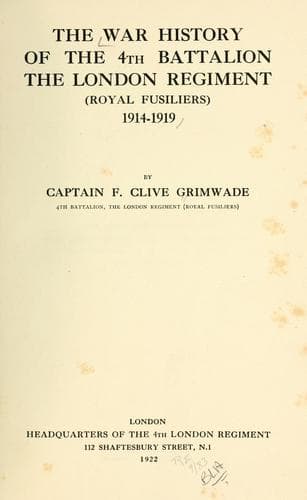
The War History of the 4th Battalion, the London Regiment (Royal Fusiliers), 1914-1919Grimwade, F. Clive
History
The War History of the 4th Battalion, the London Regiment (Royal Fusiliers), 1914-1919
Grimwade, F. Clive
Great Britain. Army. London Regiment. 4th (City of London) Battalion; World War, 1914-1918 -- Regimental histories -- Great Britain
The recruits allotted to the Regiment under this scheme were clothed
at Headquarters (though not equipped or armed) and drafted straight to
Hurdcott, and within the space of a week no fewer than 650 were posted
to the 4th (Reserve) Battalion. In the following week a party of 220
N.C.O.'s and men of the 3/4th Battalion were sent to the 4th (Reserve)
Battalion for the completion of their training, which was found on
examination to be in a variety of stages of advancement.
It will be readily appreciated that the sudden advent of so large a
body of totally untrained men strained the instructional facilities of
the Battalion to the utmost, and it was deemed advisable somewhat to
modify the system of training which had proved sufficient hitherto.
The recruits were posted to companies as usual, an extra company, E
(under Lieut. Miller), being now formed, but the company staffs assumed
responsibility only for clothing, equipment, messing, pay and other
administrative and disciplinary duties, the whole of the training
being entrusted to a specially selected staff of officers and N.C.O.
instructors, who were as far as possible relieved of company and
battalion duties. It is believed that the Battalions of the London
Reserve Division were among the first to adopt this system of coping
with the problem of draft-production which, in modified and improved
forms, gradually became recognised as the most efficient and was
generally adopted.
It should be understood that the brief description which follows of the
work of the Reserve Battalion is somewhat anticipatory. The scheme of
training which was in force in the last year of the War was obviously
not evolved in a day, but was the fruit of three years' experience. But
it is thought that the present is perhaps the most suitable juncture
for the inclusion in this history of these notes, as the period now
under review saw the inception of the great training scheme whereby the
country produced its citizen soldiers who fought the great battles of
1916, 1917 and 1918.
The system as originally evolved in the 4th Battalion was intended to
apply to "barrack-square" instruction in drill only, but as training
proceeded, it was found desirable not only to ensure uniformity of
instruction, but also for economy of instructors and the avoidance of
delay in the completion of training, to apply it to all branches of
training. "Specialist" officers and N.C.O.'s were therefore appointed
to take charge of each different subject of instruction, such as drill,
musketry, bombing, Lewis Gun, physical training and bayonet fighting,
entrenching and wiring, and "anti-gas" measures; the whole training
school being under the executive control of an "officer in charge of
training."
Public-domain text, read in full here on John Shaqi.
Reviews
Reviews
No reviews yet
Be the first to share your thoughts on this work.
Elsewhere in the archive
Join the Discussion
Join the discussion
Sign in to leave a comment or review.
Sign InorCreate an account