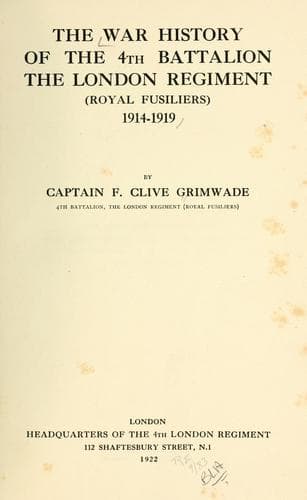
The War History of the 4th Battalion, the London Regiment (Royal Fusiliers), 1914-1919Grimwade, F. Clive
History
The War History of the 4th Battalion, the London Regiment (Royal Fusiliers), 1914-1919
Grimwade, F. Clive
Great Britain. Army. London Regiment. 4th (City of London) Battalion; World War, 1914-1918 -- Regimental histories -- Great Britain
Throughout these three months the training proceeded by platoons, each
platoon of recruits living, messing and working together, with the
object of impressing on them, from the earliest days of their service,
the importance of the platoon as a unit in action. The latter part of
the "individual" training period saw the sub-division of each platoon
into Lewis Gun and bombing sections, training being arranged for in
accordance with the particular requirements of each. The "individual"
training having been completed, the final fortnight was devoted to
platoon "combined training" in field work as a properly organised
platoon, the men working in full marching order, loaded to the weight
which they would be called upon to carry in the field. The physical
strain of the last fourteen days was undoubtedly considerable, but the
results attained by it were amply justified, not only from the point of
actual instruction imparted, but also from that of the highly important
question of selection of N.C.O.'s, for each section of the platoon in
"combined training" was in charge of a recruit N.C.O., the specialist
instructor being attached merely for the purpose of supervision.
On completion of this final and most interesting period in the
recruit's training, he proceeded on "draft-leave" for four clear days,
on return from which he was reported as ready to proceed overseas, was
medically inspected and finally fitted out; and as a rule his departure
overseas ensued within a few days.
Such was the course of life in a Reserve Battalion, and it will not
be disputed that the duties of an instructor were both multifarious
and exceedingly onerous, while the degree of personal application
and physical endurance which the recruit himself was called upon
to display was severe to a degree. Owing to the frequent changes of
personnel among the N.C.O. instructors, it is impossible to record
the names of all those who were in turn employed in this manner, but
it would be unjust not to acknowledge the splendid devotion of the
training staffs or to recognise with gratitude the extreme importance
of the rôle played by them in the War. Neither can we refrain from
remarking that, however complete the scheme of training, and however
efficient the instructors, it would have been nearly impossible to
carry it into effect in the short period allowed but for the intense
keenness and willingness to learn displayed by the vast majority of the
many thousands of recruits who were trained in accordance with it.
Public-domain text, read in full here on John Shaqi.
Reviews
Reviews
No reviews yet
Be the first to share your thoughts on this work.
Elsewhere in the archive
Join the Discussion
Join the discussion
Sign in to leave a comment or review.
Sign InorCreate an account