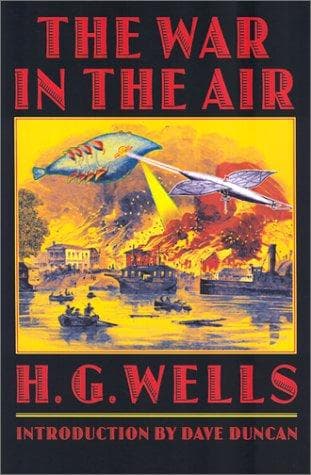
Air warfare -- Fiction; Science fiction; War stories
It was only very slowly that Bert got hold of this idea that the
whole world was at war, that he formed any image at all of the crowded
countries south of these Arctic solitudes stricken with terror and
dismay as these new-born aerial navies swept across their skies. He
was not used to thinking of the world as a whole, but as a limitless
hinterland of happenings beyond the range of his immediate vision. War
in his imagination was something, a source of news and emotion, that
happened in a restricted area, called the Seat of War. But now the whole
atmosphere was the Seat of War, and every land a cockpit. So closely had
the nations raced along the path of research and invention, so secret
and yet so parallel had been their plans and acquisitions, that it was
within a few hours of the launching of the first fleet in Franconia
that an Asiatic Armada beat its west-ward way across, high above the
marvelling millions in the plain of the Ganges. But the preparations
of the Confederation of Eastern Asia had been on an altogether more
colossal scale than the German. “With this step,” said Tan Ting-siang,
“we overtake and pass the West. We recover the peace of the world that
these barbarians have destroyed.”
Their secrecy and swiftness and inventions had far surpassed those of
the Germans, and where the Germans had had a hundred men at work the
Asiatics had ten thousand. There came to their great aeronautic parks
at Chinsi-fu and Tsingyen by the mono-rails that now laced the whole
surface of China a limitless supply of skilled and able workmen, workmen
far above the average European in industrial efficiency. The news of the
German World Surprise simply quickened their efforts. At the time of the
bombardment of New York it is doubtful if the Germans had three hundred
airships all together in the world; the score of Asiatic fleets flying
east and west and south must have numbered several thousand. Moreover
the Asiatics had a real fighting flying-machine, the Niais as they were
called, a light but quite efficient weapon, infinitely superior to the
German drachenflieger. Like that, it was a one-man machine, but it
was built very lightly of steel and cane and chemical silk, with a
transverse engine, and a flapping sidewing. The aeronaut carried a gun
firing explosive bullets loaded with oxygen, and in addition, and true
to the best tradition of Japan, a sword. Mostly they were Japanese, and
it is characteristic that from the first it was contemplated that the
aeronaut should be a swordsman. The wings of these flyers had bat-like
hooks forward, by which they were to cling to their antagonist's
gas-chambers while boarding him. These light flying-machines were
carried with the fleets, and also sent overland or by sea to the front
with the men. They were capable of flights of from two to five hundred
miles according to the wind.
Public-domain text, read in full here on John Shaqi.
Reviews
Reviews
No reviews yet
Be the first to share your thoughts on this work.
Elsewhere in the archive
Join the Discussion
Join the discussion
Sign in to leave a comment or review.
Sign InorCreate an account