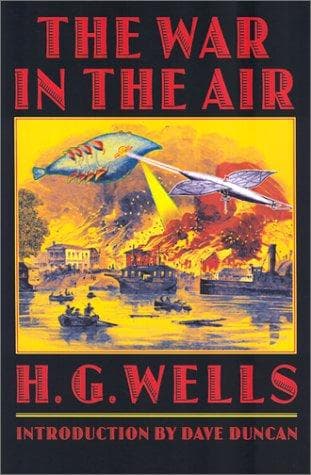
Air warfare -- Fiction; Science fiction; War stories
So, hard upon the uprush of the first German air-fleet, these Asiatic
swarms took to the atmosphere. Instantly every organised Government in
the world was frantically and vehemently building airships and whatever
approach to a flying machine its inventors had discovered. There was no
time for diplomacy. Warnings and ultimatums were telegraphed to and fro,
and in a few hours all the panic-fierce world was openly at war, and at
war in the most complicated way. For Britain and France and Italy had
declared war upon Germany and outraged Swiss neutrality; India, at the
sight of Asiatic airships, had broken into a Hindoo insurrection
in Bengal and a Mohametan revolt hostile to this in the North-west
Provinces--the latter spreading like wildfire from Gobi to the Gold
Coast--and the Confederation of Eastern Asia had seized the oil wells of
Burmha and was impartially attacking America and Germany. In a week they
were building airships in Damascus and Cairo and Johannesburg; Australia
and New Zealand were frantically equipping themselves. One unique and
terrifying aspect of this development was the swiftness with which these
monsters could be produced. To build an ironclad took from two to four
years; an airship could be put together in as many weeks. Moreover,
compared with even a torpedo boat, the airship was remarkably simple to
construct, given the air-chamber material, the engines, the gas plant,
and the design, it was really not more complicated and far easier than
an ordinary wooden boat had been a hundred years before. And now from
Cape Horn to Nova Zembla, and from Canton round to Canton again, there
were factories and workshops and industrial resources.
And the German airships were barely in sight of the Atlantic waters, the
first Asiatic fleet was scarcely reported from Upper Burmah, before the
fantastic fabric of credit and finance that had held the world together
economically for a hundred years strained and snapped. A tornado of
realisation swept through every stock exchange in the world; banks
stopped payment, business shrank and ceased, factories ran on for a
day or so by a sort of inertia, completing the orders of bankrupt and
extinguished customers, then stopped. The New York Bert Smallways saw,
for all its glare of light and traffic, was in the pit of an economic
and financial collapse unparalleled in history. The flow of the food
supply was already a little checked. And before the world-war had lasted
two weeks--by the time, that is, that mast was rigged in Labrador--there
was not a city or town in the world outside China, however far from
the actual centres of destruction, where police and government were not
adopting special emergency methods to deal with a want of food and a
glut of unemployed people.
Public-domain text, read in full here on John Shaqi.
Reviews
Reviews
No reviews yet
Be the first to share your thoughts on this work.
Elsewhere in the archive
Join the Discussion
Join the discussion
Sign in to leave a comment or review.
Sign InorCreate an account