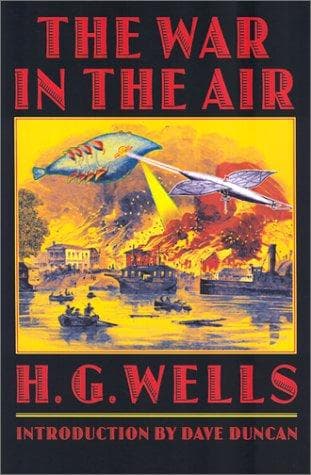
Air warfare -- Fiction; Science fiction; War stories
These aspects of aerial fighting took the world by surprise. There had
been no foresight to deduce these consequences. If there had been, the
world would have arranged for a Universal Peace Conference in 1900.
But mechanical invention had gone faster than intellectual and social
organisation, and the world, with its silly old flags, its silly
unmeaning tradition of nationality, its cheap newspapers and cheaper
passions and imperialisms, its base commercial motives and habitual
insincerities and vulgarities, its race lies and conflicts, was taken by
surprise. Once the war began there was no stopping it. The flimsy fabric
of credit that had grown with no man foreseeing, and that had held those
hundreds of millions in an economic interdependence that no man clearly
understood, dissolved in panic. Everywhere went the airships dropping
bombs, destroying any hope of a rally, and everywhere below were
economic catastrophe, starving workless people, rioting, and social
disorder. Whatever constructive guiding intelligence there had been
among the nations vanished in the passionate stresses of the time. Such
newspapers and documents and histories as survive from this period
all tell one universal story of towns and cities with the food supply
interrupted and their streets congested with starving unemployed; of
crises in administration and states of siege, of provisional Governments
and Councils of Defence, and, in the cases of India and Egypt,
insurrectionary committees taking charge of the re-arming of the
population, of the making of batteries and gun-pits, of the vehement
manufacture of airships and flying-machines.
One sees these things in glimpses, in illuminated moments, as if through
a driving reek of clouds, going on all over the world. It was the
dissolution of an age; it was the collapse of the civilisation that
had trusted to machinery, and the instruments of its destruction were
machines. But while the collapse of the previous great civilisation,
that of Rome, had been a matter of centuries, had been a thing of phase
and phase, like the ageing and dying of a man, this, like his killing by
railway or motor car, was one swift, conclusive smashing and an end.
2
The early battles of the aerial war were no doubt determined by attempts
to realise the old naval maxim, to ascertain the position of the enemy's
fleet and to destroy it. There was first the battle of the Bernese
Oberland, in which the Italian and French navigables in their flank
raid upon the Franconian Park were assailed by the Swiss experimental
squadron, supported as the day wore on by German airships, and then
the encounter of the British Winterhouse-Dunn aeroplanes with three
unfortunate Germans.
Then came the Battle of North India, in which the entire Anglo-Indian
aeronautic settlement establishment fought for three days against
overwhelming odds, and was dispersed and destroyed in detail.
Public-domain text, read in full here on John Shaqi.
Reviews
Reviews
No reviews yet
Be the first to share your thoughts on this work.
Elsewhere in the archive
Join the Discussion
Join the discussion
Sign in to leave a comment or review.
Sign InorCreate an account