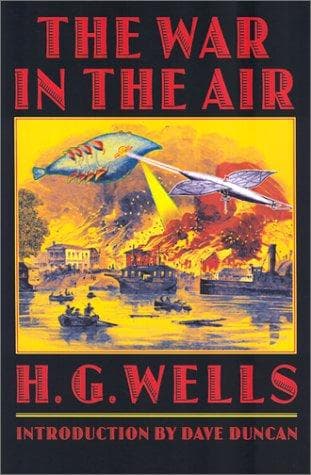
Air warfare -- Fiction; Science fiction; War stories
And if the airships were too ineffective, the early drachenflieger were
either too unstable, like the German, or too light, like the Japanese,
to produce immediately decisive results. Later, it is true, the
Brazilians launched a flying-machine of a type and scale that was
capable of dealing with an airship, but they built only three or four,
they operated only in South America, and they vanished from history
untraceably in the time when world-bankruptcy put a stop to all further
engineering production on any considerable scale.
The third peculiarity of aerial warfare was that it was at once
enormously destructive and entirely indecisive. It had this unique
feature, that both sides lay open to punitive attack. In all previous
forms of war, both by land and sea, the losing side was speedily unable
to raid its antagonist's territory and the communications. One fought
on a “front,” and behind that front the winner's supplies and resources,
his towns and factories and capital, the peace of his country, were
secure. If the war was a naval one, you destroyed your enemy's battle
fleet and then blockaded his ports, secured his coaling stations, and
hunted down any stray cruisers that threatened your ports of commerce.
But to blockade and watch a coastline is one thing, to blockade and
watch the whole surface of a country is another, and cruisers and
privateers are things that take long to make, that cannot be packed up
and hidden and carried unostentatiously from point to point. In aerial
war the stronger side, even supposing it destroyed the main battle fleet
of the weaker, had then either to patrol and watch or destroy every
possible point at which he might produce another and perhaps a novel and
more deadly form of flyer. It meant darkening his air with airships. It
meant building them by the thousand and making aeronauts by the hundred
thousand. A small uninitated airship could be hidden in a railway
shed, in a village street, in a wood; a flying machine is even less
conspicuous.
And in the air are no streets, no channels, no point where one can
say of an antagonist, “If he wants to reach my capital he must come by
here.” In the air all directions lead everywhere.
Consequently it was impossible to end a war by any of the established
methods. A, having outnumbered and overwhelmed B, hovers, a thousand
airships strong, over his capital, threatening to bombard it unless B
submits. B replies by wireless telegraphy that he is now in the act of
bombarding the chief manufacturing city of A by means of three raider
airships. A denounces B's raiders as pirates and so forth, bombards B's
capital, and sets off to hunt down B's airships, while B, in a state of
passionate emotion and heroic unconquerableness, sets to work amidst his
ruins, making fresh airships and explosives for the benefit of A.
The war became perforce a universal guerilla war, a war inextricably
involving civilians and homes and all the apparatus of social life.
Public-domain text, read in full here on John Shaqi.
Reviews
Reviews
No reviews yet
Be the first to share your thoughts on this work.
Elsewhere in the archive
Join the Discussion
Join the discussion
Sign in to leave a comment or review.
Sign InorCreate an account