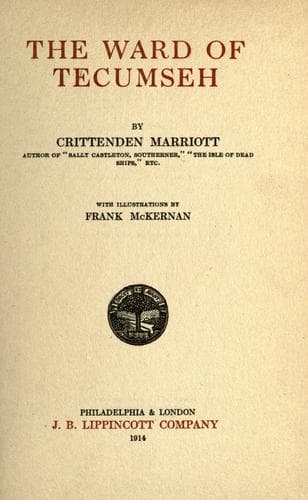
Indians of North America -- Wars -- 1812-1815 -- Fiction; United States -- History -- War of 1812 -- Fiction
Of them all none took the blow harder than Jaqueline Telfair, commonly
known as Jack. Jack was just twenty-one, and the fact that he was a
full year younger than Miss Habersham, had lain like a blight over the
whole course of his wooing. In any other part of the land he might have
concealed his lack of years, for he was unusually tall and broad and
strong, but he could not do so at his home in Alabama, where everybody
had known everything about everybody for two hundred years and more.
Still, Jack hoped against hope and refused to believe the news until he
received it from Miss Habersham’s own lips.
Miss Habersham, by the way, was not quite so composed as she tried
to be when she told him. Jack was so big and fine and looked at her
so straight and, altogether, was such a lovable boy that her heart
throbbed most unaccountably and before she quite knew what she was
doing she had leaned forward and kissed him on the lips. “Good-by,
Jack, dear,” she said softly. Then, while Jack stood petrified, she
turned and fled. She did not love Jack in the least and she did love
Dick Ogilvie, but--Oh! well! Jack was a gentleman; he would understand.
Jack did understand. For a few seconds he stood quite still; then he
too walked away, white faced and silent.
The next morning he went out to hunt; that is, he took a light shot-gun
and tramped away into the half dozen square miles of tangled woodland
that lay at the back of the Telfair barony along the Tallapoosa River.
But as he left his dog and his negro body-servant, Cato, at home, he
probably went to be alone rather than to kill.
Spring was just merging into summer, and the sun spots were dancing in
the perfumed air across the tops of the grasses. Great butterflies were
flitting over the painted buttercups and ox-eyed daisies, skimming the
shiny gossamers beneath which huge spiders lay in wait. From every bush
came the twitter of nestlings or the wing flash of busy bird parents.
Squirrels, red and gray, flattening themselves against the bark, peered
round the trunks of great trees with bright, suspicious eyes. Molly
cottontails crouched beneath the growing brambles. Round about lay the
beautiful woodland, range after range of cobweb-sheeted glades splashed
with yellow light. Crisp oaks and naked beeches, mingled with dark
green hemlocks and burnished quivering pines, towered above bushes of
sumach and dogwood, twined and intertwined with swift-growing dewberry
vines. From somewhere on the right came the sound of water rippling
over a pebbly bed.
Public-domain text, read in full here on John Shaqi.
Reviews
Reviews
No reviews yet
Be the first to share your thoughts on this work.
Join the Discussion
Join the discussion
Sign in to leave a comment or review.
Sign InorCreate an account