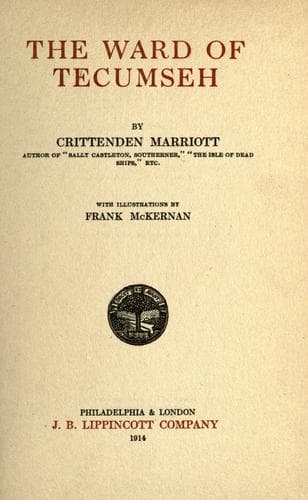
Indians of North America -- Wars -- 1812-1815 -- Fiction; United States -- History -- War of 1812 -- Fiction
Thirty years before men had fought their way over every inch of that
trail, dying by scores along it from the arrow, the tomahawk, and the
bullet. But that had been thirty years before. For twenty years the
trail had been safe as far as the Ohio; for ten it had been measurably
safe halfway up the state, to the edge of the Indian country.
Throughout the journey Jack tried hard to be mournful. Every dawn as
he opened his eyes on a world new created, vivid, baptized with the
consecration of the dew, he reminded himself that life could hold no
happiness for him--since Sally Habersham had given her hand to another.
Every noontide as he saw the fields swelling with the growing grain,
the apples shaping themselves out of the air, the vagrant butterflies
seeking their painted mates above the deep, moist, clover-carpeted
meadows, he told himself that for him alone all the vast processes of
nature had ceased. Every evening, when the landscape smouldered in the
setting sun, when the red lights burned across the tips of the waving
grasses, when the burnished pines pointed aspiringly higher, when the
rushing rapids on the chance streams glittered in sparkling points of
multi-colored fire, he assured himself that to himself there remained
only the hard, straight path of duty.
Yet, in spite of himself, the edge of his grief grew slowly but surely
dull. The bourgeoning forests, the swelling mountains, the vast
stretches of solitude were all so many veils stretched between him and
the past. His love for Sally Habersham did not lessen, perhaps, but
it became unreal, like the memory of a dear, dead dream that held no
bitterness. It was hard to brood on the life of gallant and lady, of
silver and damask, of polished floors and stately minuets, when his
every waking minute had to be spent in meeting the intensely practical
problems that beset the pioneers. It was hard to assure himself that he
would live and die virgin and that his house should die with him, when,
as often as not, he dropped off to sleep in the same house, if not the
same room, with a dozen or more sturdy boys and girls that were being
raised by one of those same pioneers and his no less vigorous wife.
Besides, Cato would not let him brood. Cato had feminine problems of
his own which he insisted on submitting to his master’s judgment. When
rebuffed, he preserved an injured silence till he judged that Jack’s
mood had softened and then returned blandly to the charge. Very early
on the trip Jack gave up in despair all attempts to check his menial’s
tongue; he realized that nothing short of death would do this, and he
could not afford to murder his only companion, though he often felt as
if he would like to do it.
Public-domain text, read in full here on John Shaqi.
Reviews
Reviews
No reviews yet
Be the first to share your thoughts on this work.
Join the Discussion
Join the discussion
Sign in to leave a comment or review.
Sign InorCreate an account