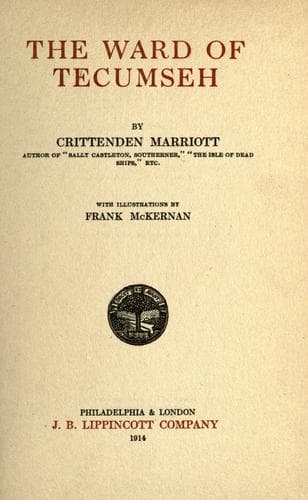
Indians of North America -- Wars -- 1812-1815 -- Fiction; United States -- History -- War of 1812 -- Fiction
And now he had sent for him, sent for him over nearly a thousand
miles of prairie, swamp, and forest, past hostile Indian villages and
suspicious white men. Jack thought of it and marvelled. Few white men
would do so much to keep a pledge to a friend ten years dead!
As he pondered Jack had been pacing slowly homeward. At last he halted
on a rustic bridge thrown across a swift-flowing little creek that
sang merrily through the woodland. On the hill beyond, at the crest of
a velvety shadow-flecked lawn, rose the white-stoned walls of the home
where he had been born and bred. Around it stretched acres of field
and orchard, vivid with the delicate blossoms of apples and of plums,
the pink-white haze of peach, the light green spears of corn, and the
darker green of tobacco. Over his head a belted kingfisher screamed,
a crimson cardinal flashed like a live coal from tree to tree, a
woodpecker drummed at a tree. Below flashed the creek, a singing water
pebbled with pearls. Jack did not see nor hear them; arms on rail he
stared blankly, pondering.
A voice startled him and he swung round to face his body-servant, Cato,
a negro a few years older than himself.
Cato was panting. “Massa Colonel’s home, suh,” he gasped. “An’ he want
you, suh. He’s in a pow’ful hurry.”
Jack stared at the boy. “Father home!” he exclaimed, half to himself.
“I didn’t expect him for hours.”
“He’s done got home, suh. He ride Black Rover most near to death, suh.
Yes, suh! He’s in most pow’ful hurry.”
CHAPTER II
COLONEL TELFAIR was striding excitedly up and down the wide verandah,
lashing as he went at the tall riding boots he wore. His plum-colored,
long-skirted riding coat, his much-beruffled white shirt, and his
tight-fitting breeches were dusty and spattered with dried mud. It
needed not the white-lathered horse with drooping head that a negro
was leading from the horseblock to show that he had ridden fast and
furiously.
From one end of the porch to the other he strode, stopping at each to
scan the landscape, then restlessly paced back again. A dozen negroes
racing in every direction confirmed the urgent haste that his manner
showed.
Abruptly he paused as Jack, followed by Cato, came hurrying up the
drive. “Hurry, sir, hurry,” he bawled. “Don’t keep me waiting all day.”
Jack quickened his steps. “I didn’t know you were back, father,”
he declared, as he came close. “I’m glad you are, sir. I’ve news,
important news!”
The elder Telfair scowled. “News, have you, sir?” he rumbled. “So
have I. Come inside, quick, and we’ll exchange.” Turning, he led
the way through a deep hall into a great room, whose oak-panelled
walls were hung with full-length portraits of dead and gone
Telfairs--distinguished men and women whose strong faces showed that
in their time they had cut a figure in the world. There he faced round.
“Now, sir, tell your news,” he ordered. “I’ll warrant it’s short and
foolish.”
Public-domain text, read in full here on John Shaqi.
Reviews
Reviews
No reviews yet
Be the first to share your thoughts on this work.
Join the Discussion
Join the discussion
Sign in to leave a comment or review.
Sign InorCreate an account