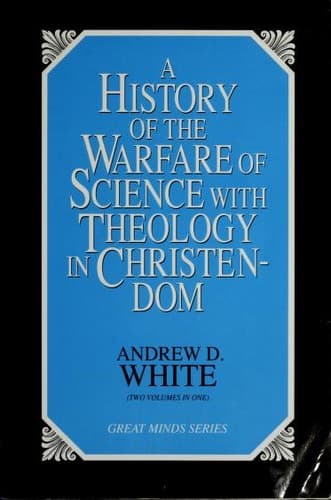
Religion and science; Religion and science -- History; Science -- History
Melanchthon, mild as he was, was not behind Luther in condemning
Kopernik. In his treatise, _Initia Doctrinæ Physicæ_, he says:
"The eyes are witnesses that the heavens revolve in the space of
twenty-four hours. But certain men, either from the love of novelty,
or to make a display of ingenuity, have concluded that the earth
moves; and they maintain that neither the eighth sphere nor the sun
revolves.... Now, it is a want of honesty and decency to assert such
notions publicly, and the example is pernicious. It is the part of a
good mind to accept the truth as revealed by God, and to acquiesce
in it." Melanchthon then cites passages from the Psalms and from
Ecclesiastes which he declares assert positively and clearly that the
earth stands fast, and that the sun moves around it, and adds eight
other proofs of his proposition that "the earth can be nowhere, if not
in the centre of the universe."[30]
And Protestant people were not a whit behind Catholic in following
out these teachings. The people of Elbing made themselves merry over a
farce in which Kopernik was the main object of ridicule. The people of
Nuremberg, a great Protestant centre, caused a medal to be struck, with
inscriptions ridiculing the philosopher and his theory.[31]
Then was tried, also, one piece of strategy very common formerly in
battles between theologians themselves. It consists in loud shoutings
that the doctrine attacked is outworn, and already refuted--that
various distinguished gentlemen have proved it false--that it is not
a living truth, but a detected lie--that, if the world listens to it,
that is simply because the world is ignorant. This strategy was brought
to bear on Kopernik. It was shown that his doctrine was simply a
revival of the Pythagorean notion, which had been thoroughly exploded.
Fromundus, as we have seen in his title-page and throughout his book,
delights in referring to the doctrine of the revolution of the planets
around the sun, as "that Pythagorean notion." This mode of warfare
was imitated by the lesser opponents, and produced, for some time,
considerable effect.[32]
But the new truth could neither be laughed down nor forced down. Many
minds had received it; only one tongue dared utter it. This new warrior
was that strange mortal, Giordano Bruno. He was hunted from land to
land, until, at last, he turns on his pursuers with fearful invectives.
For this he is imprisoned six years, then burned alive and his ashes
scattered to the winds. Still the new truth lived on; it could not
be killed. Within ten years after the martyrdom of Bruno,[33] after
a world of troubles and persecutions, the truth of the doctrine of
Kopernik was established by the telescope of Galileo.[34]
Public-domain text, read in full here on John Shaqi.
Reviews
Reviews
No reviews yet
Be the first to share your thoughts on this work.
Join the Discussion
Join the discussion
Sign in to leave a comment or review.
Sign InorCreate an account