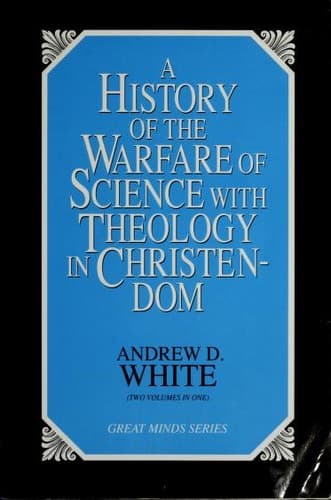
Religion and science; Religion and science -- History; Science -- History
But the little telescope of Galileo still swept the heavens, and the
next revelation announced was the system of mountains and valleys
in the moon. This was a signal for another attack. It was declared
that this, coupled with the statement that the moon shines by light
reflected from the sun, was a contradiction of the statement in
Genesis that the moon is a "great light" like the sun. To make the
matter worse, a painter, placing the moon in a religious picture in
its usual position beneath the feet of the Blessed Virgin, outlined on
its surface mountains and valleys; this was denounced as a sacrilege
logically resulting from the astronomer's heresy.
The next struggle was aroused when the hated telescope revealed spots
upon the sun, and their motion, which indicated the sun's rotation.
Monsignor Elci, head of the University of Pisa, forbade the Professor
of Astronomy, Castelli, to mention these spots. Father Busaeus, at
the University of Innspruck, forbade the astronomer Scheiner to allow
the new discovery to be known there. At the College of Douay and the
University of Louvain it was expressly placed under the ban, and this
became the general rule among the Catholic universities and colleges
of Europe. The Spanish universities were specially intolerant of this
and similar ideas,[45] and up to a recent period they were strictly
forbidden in the most important university of all--that of Salamanca.
In 1820 the Abbé Settele, professor at the College of Rome, having
announced a work on Optics and Astronomy, the master of the sacred
palace, under the authority of the old decrees against the teachings
of Kopernik and Galileo, forbade the publication, and it was not until
1822 that Pope Pius VII. sanctioned a decision of the Inquisition
permitting such teachings.[46]
Such are the consequences of placing the instruction of men's minds
in the hands of those mainly absorbed in the work of saving men's
souls.[47] Nothing could be more in accordance with the idea recently
put forth by the Bishop of Montpellier, that the Church is alone
fully empowered to promulgate scientific truth or direct university
instruction; but science gained the victory here also. News came of
observations of the solar spots, not only from Galileo in Italy, but
from Fabricius in Holland. Father Scheiner then endeavors to make the
usual treaty; he promulgates a pseudo-scientific theory--a statement
based on a "religious science"--which only provokes derision.
But the war grew more and more bitter, and the principal weapons in it
are worth examining. They are very easily examined; you may pick them
up on any of the battle-fields of science; but on that field they were
used with more effect than on almost any other. These weapons are two
epithets: "Infidel" and "Atheist."
Public-domain text, read in full here on John Shaqi.
Reviews
Reviews
No reviews yet
Be the first to share your thoughts on this work.
Join the Discussion
Join the discussion
Sign in to leave a comment or review.
Sign InorCreate an account