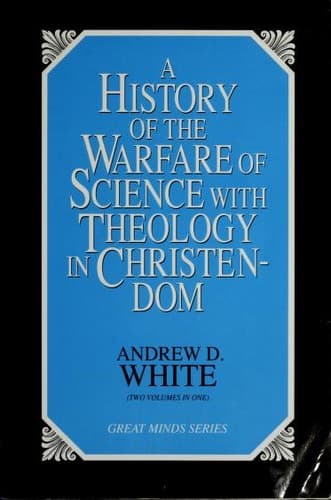
Religion and science; Religion and science -- History; Science -- History
Nor was this all. To the end of his life, nay, after his life was
ended, this bitter persecution was continued, on the supposition that
the great truths he revealed were hurtful to religion. After a brief
stay in the dungeons of the Inquisition, he was kept in exile from
family, friends, all his noble employments, and held rigidly to his
promise not even to speak of his theory. When, in the midst of intense
bodily sufferings from disease and mental sufferings from calamities in
his family, he besought some little liberty, he was met with threats
of a recommittal to his dungeon. When, at last, a special commissioner
had reported to the ecclesiastical authorities that Galileo had
become blind and wasted away with disease and sorrow, he was allowed
but little more liberty, and that little tempered by the close
surveillance of the ecclesiastical authorities. He was forced to bear
contemptible attacks on himself and on his works in silence; he lived
to see his ideas carefully weeded out from all the church colleges and
universities in Europe; and when, in a scientific work, he happened to
be spoken of as "renowned," the Inquisition ordered the substitution of
the word "notorious."[54]
Nor did the persecution cease with his death. Galileo had begged to be
buried in his family tomb in Santa Croce; the request was denied: his
friends wished to erect a monument over him; this, too, was refused.
Pope Urban said to the embassador Niccolini that "it would be an evil
example for the world if such honors were rendered to a man who had
been brought before the Roman Inquisition for an opinion so false and
erroneous, who had communicated it to many others, and who had given
so great a scandal to Christendom."[55]
In accordance, therefore, with the wish of the pope and the orders of
the Inquisition, Galileo was buried ignobly, apart from his family,
without fitting ceremony, without monument, without epitaph. Not
until forty years after did Pierozzi dare to write his epitaph. Not
until a hundred years after did Nelli dare transfer his remains to
Santa Croce and erect above them a suitable monument. Even then the
old conscientious hostility burst out: the Inquisition was besought
to prevent such honors to "a man condemned for notorious errors;" and
that tribunal refused to allow any epitaph to be placed above him
which had not first been submitted to its censorship. Nor has that
old conscientious consistency in hatred yet fully relented; hardly a
generation since has not seen some Marini, or De Bonald, or Rallaye,
or De Gabriac, suppressing evidence, or torturing expressions, or
inventing theories, to blacken the memory of Galileo and save the
reputation of the Church.[56]
Public-domain text, read in full here on John Shaqi.
Reviews
Reviews
No reviews yet
Be the first to share your thoughts on this work.
Join the Discussion
Join the discussion
Sign in to leave a comment or review.
Sign InorCreate an account