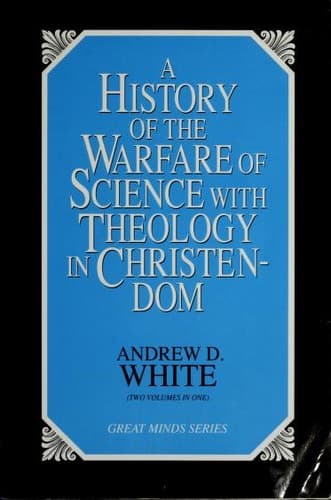
Religion and science; Religion and science -- History; Science -- History
"The fictions, too, of those who have not feared to deduce and confirm
from the principles and authority of philosophies the true Christian
religion, have the same tendency, though in a different way. These
celebrated the wedding of faith and sense, as though it were lawful,
with much pomp and solemnity, and soothed the minds of men with a
grateful variety of things, but, meanwhile, mingled the divine with
the human in ill-matched state. And in mixtures like this of theology
with natural philosophy, those things only which are now received in
philosophy are included; while novelties, though they be changes for
the better, are all banished and driven out."
And, again, Bacon says: "Lastly you may find, thanks to the
unskillfulness of some divines, the approach to any kind of philosophy,
however improved, entirely closed up. Some, indeed, in their simplicity
are rather afraid, lest perhaps a deeper inquiry into Nature should
penetrate beyond the allowed limits of sobriety." Still further on
Bacon penetrates into the very heart of the question in a vigorous way,
and says: "Others, more craftily, conjecture and consider that, if the
means be unknown, each single thing can be referred more easily to the
hand and rod of God--a matter, as they think, of very great importance
to religion: and this is nothing more nor less than wishing to _please
God by a lie_." And, finally, he says: "Whereas, if one considers the
matter rightly, natural philosophy is, after God's word, the surest
medicine for superstition, and also the most approved nourishment of
faith."[92]
No man who has thought much upon the annals of his race can, without
a feeling of awe, come into the presence of such inspired clearness
of insight and boldness of utterance. The first thought of the reader
is, that, of all men, this Francis Bacon is the most free from the
unfortunate bias he condemns. He certainly cannot be deluded into the
old path. But, as we go on through the treatise, we are surprised
to find that the strong arm of Aquinas had been stretched over the
intervening ages, and had laid hold upon this master-thinker of the
sixteenth century. Only a few chapters further along we find Bacon,
after alluding to the then recent voyage of Columbus, speaking of the
prophecy of Daniel regarding the latter days, that "many shall run to
and fro and knowledge be increased," as "clearly signifying that it is
in the fates, i. e., in providence, that the circumnavigation of the
world, which through so many lengthy voyages seems to be entirely
complete or in course of completion, and the increase of science,
should happen in the same age."[93]
Here, then, we have this great man indulging in that very mixture of
literal Scriptural interpretation and scientific thought which he had
condemned, and therefrom evidently deducing the conclusion that these
great voyages and discoveries, which were the beginning of a new world
in thought and action, were the end of all things.
Public-domain text, read in full here on John Shaqi.
Reviews
Reviews
No reviews yet
Be the first to share your thoughts on this work.
Join the Discussion
Join the discussion
Sign in to leave a comment or review.
Sign InorCreate an account