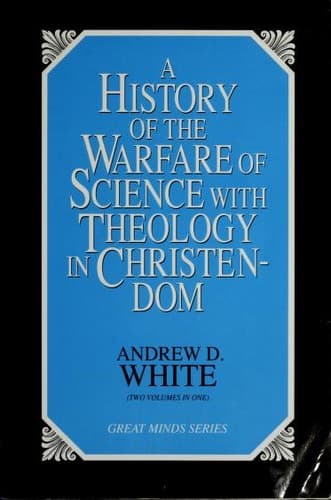
Religion and science; Religion and science -- History; Science -- History
But, despite the persecution of Bacon and the defection of those who
ought to have followed him, champions of natural science and the
experimental method arose from time to time during the succeeding
centuries. We know little of them personally. Our main knowledge of
their efforts is derived from the efforts of their opponents and
persecutors.
In 1317 Pope John XXII. issued his bull _Spondent Pariter_, nominally
leveled at the alchemists, but really dealing a terrible blow at the
beginnings of the science of chemistry.
In 1380 Charles V. of France carried out the same policy, and even
forbade the possession of furnaces and apparatus necessary for chemical
processes. Under this law the chemist John Barillon, for possessing
chemical furnaces and apparatus, was thrown into prison, and it was
only by the greatest effort that his life was saved.
In 1404 Henry IV. of England issued a decree of the same sort; and in
1418 the republic of Venice followed the example of pope and kings. But
champions of science still pressed on. Antonio de Dominis relinquishes
his archbishopric of Spalatro, investigates the phenomena of light, and
dies in the clutches of the Inquisition.[102]
Pierre de la Ramée stands up against Aristotelianism at Paris. A royal
edict, sought by the Church, stopped his teaching, and the massacre of
St. Bartholomew ended his life.
Somewhat later, John Baptist Porta began his investigations. Despite
many absurdities, his work was most fruitful. His book on meteorology
was the first in which sound ideas were broached. His researches in
optics gave the world the camera obscura, and, possibly, the telescope.
In chemistry he seems to have been the first to show how to reduce the
metallic oxides, and thus to have laid the foundation of all those
industries based upon the staining and coloring of glass and enamels;
and, last of all, he did much to change natural philosophy from a
"black art" to a vigorous open science. He encountered the same old
policy of conscientious men. The society founded by him for physical
research, "I Secreti," was broken up, and he was summoned to Rome and
censured.[103]
In 1624 some young chemists of Paris, having taught the experimental
method and cut loose from Aristotle, the Faculty of Theology besets the
Parliament of Paris, and the Parliament prohibits this new chemical
teaching under penalty of death.[104]
The war went on in Italy. In 1657 occurred the first sitting of the
_Accademia del Cimento_, at Florence, under the presidency of Prince
Leopold dei Medici. This Academy promised great things for science. It
was open to all talent. Its only fundamental law was "the repudiation
of any favorite system or sect of philosophy, and the obligation to
investigate Nature by the pure light of experiment."
Public-domain text, read in full here on John Shaqi.
Reviews
Reviews
No reviews yet
Be the first to share your thoughts on this work.
Join the Discussion
Join the discussion
Sign in to leave a comment or review.
Sign InorCreate an account