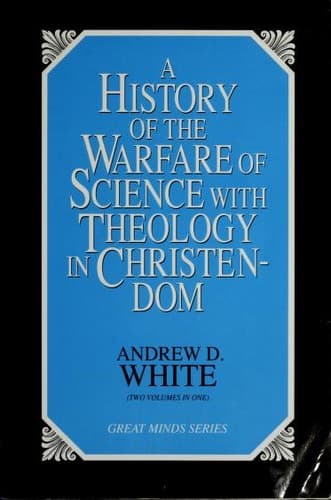
Religion and science; Religion and science -- History; Science -- History
On the heads of the anatomists and physicians were concentrated _all_
these missiles. The charge of atheism ripened into a proverb: "_Ubi
sunt tres medici, ibi sunt duo athei_." Magic seemed so common a
charge that many of the physicians seemed to believe it themselves.
Mohammedanism and Averroism became almost synonymous with medicine, and
Petrarch stigmatized Averroists as "men who deny Genesis and bark at
Christ."[110]
Not to weary you with the details of earlier struggles, I will select
a great benefactor of mankind and champion of scientific truth at
the period of the revival of learning and the Reformation--Andreas
Vesalius, the founder of the modern science of anatomy. The battle
waged by this man is one of the glories of our race.
The old methods were soon exhausted by his early fervor, and he sought
to advance science by truly scientific means--by patient investigation
and by careful recording of results.
From the outset Vesalius proved himself a master. In the search for
real knowledge he braved the most terrible dangers. Before his time
the dissection of the human subject was thought akin to sacrilege.
Occasionally an anatomist, like Mundinus, had given some little display
with such a subject; but, for the purposes of _investigation_, such
dissection was forbidden.[111] As we have already seen, even such men
in the early Church as Tertullian and St. Augustine held anatomy in
abhorrence, and Boniface VIII. interdicted dissection as sacrilege.
Through this sacred conventionalism Vesalius broke without fear.
Braving ecclesiastical censure and popular fury, he studied his science
by the only method that could give useful results. No peril daunted
him. To secure the material for his investigations, he haunted gibbets
and charnel-houses; in this search he risked alike the fires of the
Inquisition and the virus of the plague. First of all men he began to
place the science of human anatomy on its solid, modern foundations--on
careful examination and observation of the human body. This was his
first great sin, and it was soon aggravated by one considered even
greater.
Perhaps the most unfortunate thing that has ever been done for
Christianity is the tying it to forms of science which are doomed and
gradually sinking. Just as, in the time of Roger Bacon, excellent but
mistaken men devoted all their energies to binding Christianity to
Aristotle; just as, in the time of Reuchlin and Erasmus, they insisted
on binding Christianity to Thomas Aquinas: so, in the time of Vesalius,
such men made every effort to link Christianity to Galen.
Public-domain text, read in full here on John Shaqi.
Reviews
Reviews
No reviews yet
Be the first to share your thoughts on this work.
Join the Discussion
Join the discussion
Sign in to leave a comment or review.
Sign InorCreate an account