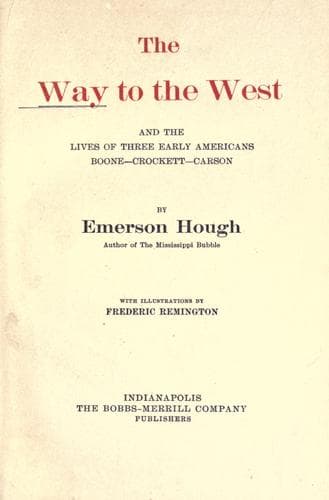
The Way to the West, and the Lives of Three Early Americans: Boone—Crockett—CarsonHough, Emerson
History
The Way to the West, and the Lives of Three Early Americans: Boone—Crockett—Carson
Hough, Emerson
Boone, Daniel, 1734-1820; Carson Kit, 1809-1868; Crockett, Davy, 1786-1836; Mississippi River Valley -- History; West (U.S.) -- History
At fifteen years of age he was called “old for his age;” he was known to
be plucky, prompt, and tenacious of his rights, though not in the least
quarrelsome. Just as well-meaning parents tried to send Davy Crockett
and Daniel Boone to school, so did the kind parents in this case
undertake to instil commercial principles into the mind of Kit Carson.
To his father it seemed important that he should be apprenticed to a
saddler. From the saddler’s stool Kit promptly fell off. It was the
out-of-doors that appealed to him; the West that spoke to him, just as
it had to Boone and Crockett. He broke his heart for two years at the
saddler’s bench, and that ended both his commercial and scholastic
education. In 1826, while still but a boy, he was off and away across
the plains, having, without his parents’ consent, joined a party bound
for Santa Fé. Thus would the youth seek his fortune.
Carson reached Santa Fé in the month of November, 1826, and went thence
to Fernandez de Taos, eighty miles northeast of Santa Fé, and spent the
winter with an old mountaineer named Kincaid, or Kin Cade, who taught
him something of the lore of the mountains. Perhaps a little homesick,
in the spring of 1827 he started back for the East, without a penny in
his buckskin pockets. He worked back homeward on the long journey down
the Arkansas to a point about four hundred and fifty miles east of Santa
Fé, and there, at the ford of the Arkansas, met another band of traders,
west-bound, to whom he hired out as a teamster.
He again reached Santa Fé, still without a dollar, and went as teamster
thence as far south as El Paso, returned to Santa Fé, and again to Taos.
He was learning Spanish and learning New Mexico all this time. He now
hired out as cook to Ewing Young, and continued in this interesting
capacity until the spring of 1828. Again he started East, again failed
to win farther than before, and joined another west-bound party, to
reach Santa Fé a third time. Now he could do a bit in Spanish, and hence
engaged as interpreter for Colonel Tramell, and wagoned it as far south
as Chihuahua, in old Mexico. All this sounds full easy, yet even these
few journeyings hitherto covered many, many weary, blistering miles.
In far-off Chihuahua young Carson hired out as a teamster, serving in
the employ of Robert McKnight. He went to the Copper Mines, on the Gila
River, and thence back once more to Taos, which latter place was to
serve as his headquarters all his life. All this time it was Carson’s
ambition to be something better than a cook, or a teamster, or even an
interpreter. The adventurer’s blood was in his veins. It was April of
1829 when he joined Young’s party of trappers, and soon thereafter he
saw his first fight, in which the white men killed some fifteen Indians.
It is not known whether or not Carson distinguished himself in this
fight, but certainly he remained with the party, and it was no coward’s
company.
Public-domain text, read in full here on John Shaqi.
Reviews
Reviews
No reviews yet
Be the first to share your thoughts on this work.
Elsewhere in the archive
Join the Discussion
Join the discussion
Sign in to leave a comment or review.
Sign InorCreate an account