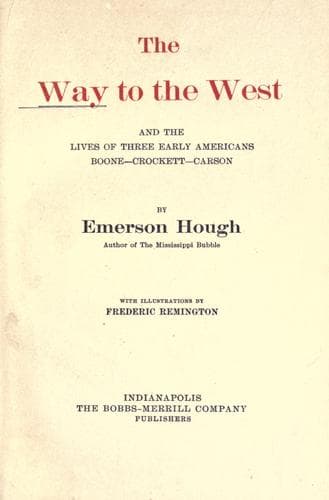
The Way to the West, and the Lives of Three Early Americans: Boone—Crockett—CarsonHough, Emerson
History
The Way to the West, and the Lives of Three Early Americans: Boone—Crockett—Carson
Hough, Emerson
Boone, Daniel, 1734-1820; Carson Kit, 1809-1868; Crockett, Davy, 1786-1836; Mississippi River Valley -- History; West (U.S.) -- History
This band now worked toward the West, trapped down the Salt River, and
reached the head of the San Francisco River. They concluded to go over
to the Sacramento River of California, then reported to abound in fur.
On the seventh day’s journey to the west and southwest, they reached the
Grand Cañon of the Colorado, now admitted to be one of the wonders of
the world. These trappers always remembered the Grand Cañon of the
Colorado; for it was near there that they bought a horse of some
wandering Indians, and ate it. They were very hungry.
There were no trails across the interior desert in those days. Hence,
although these were not the first adventurers to cross to California,
they were in effect pioneers. In some way they succeeded in reaching San
Gabriel Mission of California, and thence—by some very wonderful
geography on the part of one or two biographers—they reached the
Sacramento River. In the San Joaquin valley they met Peter Ogden’s party
of Hudson Bay trappers. So we may see that the West was far from being
an unexploited country when Kit Carson began his travels.
This early transcontinental party was successful in its trapping, and
the leader, Ewing Young, visited San Rafael with the catch of furs and
sold it out in entirety to the captain of a trading schooner. He then
bought horses for the return East. The Indians of the Sierra foothills
promptly stole certain numbers of these horses. Witness augury of the
future of Kit Carson, when we read that he was detailed as the leader of
a little party sent out in pursuit of the horse thieves. This was his
first independent scouting trip. He and his party killed eight Indians
and retook the horses. Already his hand was acquiring cunning in the
stern trade of Western life.
September of 1829 found Kit Carson back again in New Mexico. It took the
party nine days to ride from Los Angeles to the Colorado River. Thence
they seem to have descended the Colorado to tidewater, to have crossed
over to the Gila, and to have ascended the Gila to San Pedro. There was
some more horse stealing, a little exchange on both sides between the
whites and Indians in this line. The whites needed horses, for they had
no other meat. Yet in some fashion they won up the Gila River to the
copper mines of New Mexico; which, we may see, was ground already known
to Carson. Here they cached their furs, since these would be contraband
under the Spanish law, nearly all of these wanderings having taken place
in the Spanish territory that was the western goal of the early commerce
of the prairies.
Public-domain text, read in full here on John Shaqi.
Reviews
Reviews
No reviews yet
Be the first to share your thoughts on this work.
Elsewhere in the archive
Join the Discussion
Join the discussion
Sign in to leave a comment or review.
Sign InorCreate an account