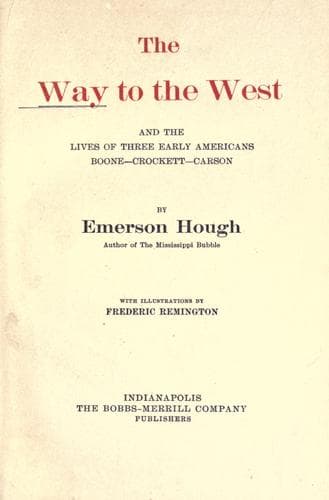
The Way to the West, and the Lives of Three Early Americans: Boone—Crockett—CarsonHough, Emerson
History
The Way to the West, and the Lives of Three Early Americans: Boone—Crockett—Carson
Hough, Emerson
Boone, Daniel, 1734-1820; Carson Kit, 1809-1868; Crockett, Davy, 1786-1836; Mississippi River Valley -- History; West (U.S.) -- History
This, then, was the end of the first exploration of the Rockies
accompanied by thermometer and barometer rather than by trap sack and
“possible bag.” It was of value. If we were asked what was the most
valuable result of this second expedition of Frémont, we should be
obliged to answer that it was his mention of the great value of the
Western grasses. Frémont was an observer, a chronicler, a writer. It was
he that first began to bring back accurate story of the resources of the
West.
The mineral wealth of the West, over which the trappers had tramped for
a quarter of a century, was as yet unsought and unsuspected by Frémont
or any one else. It was to be first the fur trade, then the mining
trade, then the cattle trade in the trans-Mississippi West; and after
that the agricultural life, followed by the days of swift
transportation, of change, of transition and expansion and gourd-like
growth in all visible ways.
We are now well forward in the third era of Kit Carson’s career. If at
first he was a trapper and hunter in order that he might become fit
guide, during the third stage of his life he was to be accepted as the
authorized guide of the most important preliminaries for the west-bound
movement of the trans-Mississippi population. After the close of the
second Frémont expedition, and during the year 1845, Carson tried to be
a ranchman or farmer, pitching his tents for the time about fifty miles
east of Taos. It was of no avail. Frémont called for him once more. The
farm was sold for half its value, and once more Carson set his face
toward the West, in company with a Frémont now older, better seasoned
and of better judgment. A more direct trail across the Great Basin and
into California was desired than that taken either in going or returning
on the second expedition.
Carson was the one to go ahead. He traveled alone for sixty miles west
of the Great Salt Lake, directly into the desert, and the rest of the
party came up to his signal smoke. Thence they pushed on to the Carson
River, searching still for a new pass over the Sierras into the valley
of the San Joaquin. At last they won across, as did the earlier
trappers, and again they reached Sutter’s Fort in due time. A branch of
the main party, that headed by Talbott, did not appear at the appointed
meeting place. It was Carson, of course, Carson the traveler, who was
despatched down the San Joaquin valley to discover the truth of a rumor
that Talbott and his party had appeared in that locality. Needless to
say the wanderers were found.
Public-domain text, read in full here on John Shaqi.
Reviews
Reviews
No reviews yet
Be the first to share your thoughts on this work.
Elsewhere in the archive
Join the Discussion
Join the discussion
Sign in to leave a comment or review.
Sign InorCreate an account