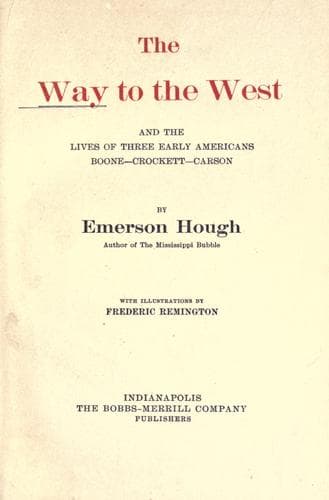
The Way to the West, and the Lives of Three Early Americans: Boone—Crockett—CarsonHough, Emerson
History
The Way to the West, and the Lives of Three Early Americans: Boone—Crockett—Carson
Hough, Emerson
Boone, Daniel, 1734-1820; Carson Kit, 1809-1868; Crockett, Davy, 1786-1836; Mississippi River Valley -- History; West (U.S.) -- History
Carson honestly did his best, but he was in the hands of a leader who
undertook to cross the Sierras with a pack-train where there was six
feet of snow, and with a party the total number of which counted only
two men that had ever before worn snowshoes in all their lives! Never
was there poorer mountaineering or worse leadership than this. But it
was not Kit Carson that was responsible.
After very many hardships, the expedition worked to the south and
southeast of the Tlamath country, and got down near to what is now known
as Pyramid Lake. Then they started across for the Sacramento, not having
discovered the fabled Buena Ventura. Carson, quiet, not boasting, openly
confessing his ignorance of a country he had never seen, none the less
in these hard conditions proved serviceable as a guide. He pushed on
ahead, and from a peak of the Sierras got a glimpse of the Coast Range.
He had not seen this Coast Range chain for seventeen years, but now he
noted two little mountains that seemed familiar to him. He told his
leader that if only they could win across the Sierras, they would
presently be in a country of warmth and plenty.
The men by that time were eating their saddle leathers, the mules were
eating each other’s tails. It was a starving, freezing time, this
foolish bit of mountain work, such as in all his trapping experience
Carson never saw equalled. Yet at last they did reach Sutter’s Fort, on
March sixth, 1844, two thousand miles from Fort Hall. Some of the men
were physically ruined and mentally deranged from their sufferings. It
was military and not mountain leadership that was responsible for all
this.
But our continually traveling man, this little man, Kit Carson, was not
to have any rest even in the pleasant valley of the Sacramento. We find
the expedition soon starting East again, now by way of the San José
valley, over the Sierras to the Mojave River, country long known to the
traveling trappers. Here Carson and his friend Godey conducted a little
enterprise of their own, undertaken in sheer knight-errantry, in behalf
of a party of Mexicans that had been nearly annihilated by the Indians.
These two men rode a hundred miles in thirty hours, and alone attacked a
large camp of Indians, killing two of them and stampeding the remainder.
The Frémont party arrived at Bent’s Fort on the Arkansas July second,
1844. They had traveled somewhere between thirty-five hundred and four
thousand miles, had circumnavigated the mysterious “Great Desert,” and
for eight months had never been out of sight of ice and snow. Frémont
was able to report upon the great Columbia River, and he and his
contemporaries did not hesitate to extol the value of Oregon as a
gateway of the Asiatic trade—a line of commerce which for half a
century did little to establish the truth of their prophecy.
Public-domain text, read in full here on John Shaqi.
Reviews
Reviews
No reviews yet
Be the first to share your thoughts on this work.
Elsewhere in the archive
Join the Discussion
Join the discussion
Sign in to leave a comment or review.
Sign InorCreate an account