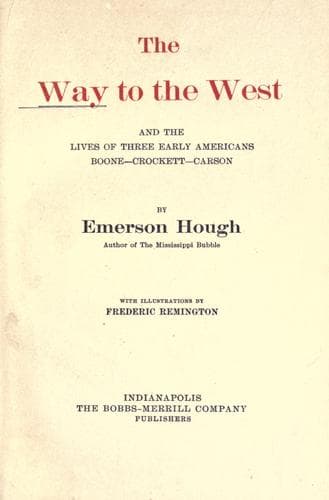
The Way to the West, and the Lives of Three Early Americans: Boone—Crockett—CarsonHough, Emerson
History
The Way to the West, and the Lives of Three Early Americans: Boone—Crockett—Carson
Hough, Emerson
Boone, Daniel, 1734-1820; Carson Kit, 1809-1868; Crockett, Davy, 1786-1836; Mississippi River Valley -- History; West (U.S.) -- History
Witness again the service of the scout and guide. Carson and Lieutenant
Beale of the Navy were sent out as special messengers to San Diego. In
some way they got through the beleaguering lines, and after a perilous
journey arrived at San Diego and secured the desired help. This sort of
thing was nothing new to Carson. It was so severe for Beale that he went
deranged, and it took him two years to recover from his journey, brave
man and bold as he was. The Army and Navy had not the seasoning of the
American mountain men, the hardiest breed ever grown on the face of the
globe.
At Los Angeles Carson finally rejoined Frémont, in time for that tempest
in a teapot wherein Frémont and Kearney fell at swords’ points. These
things are of no moment, yet it is significant that in March, 1847,
Carson was sent once more as despatch bearer to Washington. He went
light and speedy as before, met the Indians on the Gila, fought them and
won through. This time he reached Washington, after his long and steady
ride across New Mexico and down the Arkansas River to the Missouri,
arriving in the month of June, after having made four thousand miles in
three months. We make it in about three days to-day.
In Washington Carson met Jessie Benton Frémont, wife of the “Pathfinder”
and daughter of the arch-protector of the fur traders and of Frémont,
Thomas Benton. Carson was now appointed lieutenant of the rifle corps of
the United States Army; a commission which, by the way, was never
ratified, although he did not know this for some months. He was sent
back, four thousand miles, to bear despatches in return. He crossed the
Missouri River, fought the Comanches at the Point of Rocks, got through
them, pushed on west as steadily as ever, and reached the Virgin River,
in the dry Southwest, before he met his next Indian fight. He and
fifteen comrades here stood off three hundred Indians. In due time he
reached Monterey, and after this he took service against the Mexicans on
the border for a time.
So energetic a man cannot be allowed to rest, and in the spring of 1848
he is sent back once more to Washington. The physical frame of any other
man except Kit Carson had been by all these journeyings too far racked
to enable him to make this long and hazardous trip. The souls of most
men would have failed them long ere this. Yet this hardy, tough little
man, just big enough for steady riding, cheerfully undertakes his third
journey across the mountains as despatch bearer for the United States
Army.
This time he meets Utes and Apaches, fights them, wins through them, and
goes on. He stops on this trip just for a day to see his family at Taos,
averaging a visit home about once in three years. It is here that he
learns that he is not a lieutenant, after all; but that does not check
his loyalty to the flag. He goes east now up the Bijou, and down the
Platte to the Republican Fork, in order to dodge certain Indians, who,
he hears, are numerous and bad along the Arkansas.
Public-domain text, read in full here on John Shaqi.
Reviews
Reviews
No reviews yet
Be the first to share your thoughts on this work.
Elsewhere in the archive
Join the Discussion
Join the discussion
Sign in to leave a comment or review.
Sign InorCreate an account