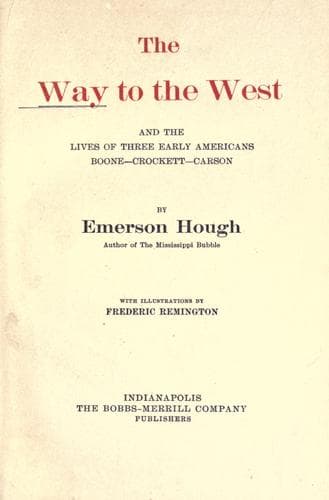
The Way to the West, and the Lives of Three Early Americans: Boone—Crockett—CarsonHough, Emerson
History
The Way to the West, and the Lives of Three Early Americans: Boone—Crockett—Carson
Hough, Emerson
Boone, Daniel, 1734-1820; Carson Kit, 1809-1868; Crockett, Davy, 1786-1836; Mississippi River Valley -- History; West (U.S.) -- History
He reaches Washington safe and sound, of course; starts back for New
Mexico; and arrives there in October, 1848. Figure yourself, if you
like, as chief actor in a quarter of a century of such traveling as was
done by Kit Carson. His travels are given thus in detail that we may
have just estimate of the man of those days, of the tremendous demands
upon his courage and endurance. Only the West could produce such a man.
Now we may picture Kit Carson in the fourth stage of his career, as
settler and rancher. He was at home now, but he knew no rest. He fought
the Apaches, and guided Colonel Beall against that tribe and the
Comanches, in an endeavor to round up all the Mexican prisoners in the
hands of the Indians, who were to be returned to their own firesides.
After this little expedition Carson was once more a man without an
occupation. There was a lull in fighting and scouting. Having no
profession except that of trapper and of guide, he cast about him and
once more determined to be a ranchman. He and his friend Maxwell
established a ranch fifty miles west of Taos, at what is known as Rayado
or Rezado. Again he joined an expedition against the Apaches, a day and
a half to the southeast, a disastrous expedition, in which he was not
leader, but might better have been. At another time he helped chase some
Apache thieves, and assisted in the killing of five of them, being
always desired in these errands of swift punishment. Our army could
never catch the Apaches, the Nez Percés, the Comanches, the Crows, the
Blackfeet. Kit Carson always could and did.
This Indian fighting, however, did not bring money to his coffers;
therefore in 1850 we find him and a partner taking a band of horses from
New Mexico up to Fort Laramie, a journey of five hundred miles.[32]
After this followed some more horse stealing on the part of the Indians,
yet more punitive expeditions, and considerable amateur sheriffing, for
which service Carson had become a necessity in the district. He was not
afraid. He could read the signs of the trails. He could ride.
In 1851 Carson and Maxwell tried their hands at a bit of the Santa Fé
trade themselves, although this was long after the glory of the old-time
wagon trade had departed. They got a train load of goods at St. Louis,
and started westward up the Arkansas, after the old-fashioned way. They
met the Cheyennes, always ambitious to acquire tax title of the plains
to such valuable property as this. Carson knew that the protestations of
these Cheyennes were not to be believed, and told the Indians that they
could neither deceive him nor frighten him; yet with diplomacy equal to
his courage, he edged on and on for three doubtful days, farther and
farther to the westward, and so at last came safe. Kit Carson was no
blusterer and no swashbuckler, but was first and last of all a good
business man. He knew that it was good judgment to keep out of a fight
whenever possible, which he did.
Public-domain text, read in full here on John Shaqi.
Reviews
Reviews
No reviews yet
Be the first to share your thoughts on this work.
Elsewhere in the archive
Join the Discussion
Join the discussion
Sign in to leave a comment or review.
Sign InorCreate an account