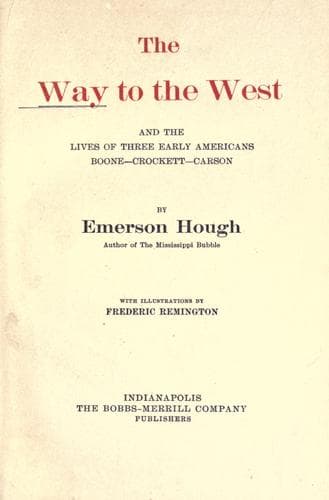
The Way to the West, and the Lives of Three Early Americans: Boone—Crockett—CarsonHough, Emerson
History
The Way to the West, and the Lives of Three Early Americans: Boone—Crockett—Carson
Hough, Emerson
Boone, Daniel, 1734-1820; Carson Kit, 1809-1868; Crockett, Davy, 1786-1836; Mississippi River Valley -- History; West (U.S.) -- History
To-day we think in straight lines. We believe, ignorantly, that our
forefathers moved directly westward from their former homes. We do not
ask how they did it, but think that in some way they must have done so.
Dwellers in Chicago think of New York, and it means New York in a
straight line due east. They think of California, and it implies a
straight line due west. To us of to-day all railroads run without
curves, and are governed only by time-schedules, which annually grow
shorter. Geography is well-nigh a lost art. Indeed, there is but little
use for it, since the time-tables of the great railways answer all our
questions so conclusively. To-day it matters not to us what may be the
course of a journey; the sole question is as to the time that journey
will require. The railroad men do our thinking for us. We do not concern
ourselves with how those good, but somewhat old-fashioned folk, our
ancestors, got about in a country that once was large. We care not at
all for matters of down-stream or up-stream.
In a general way, therefore, we are prone to believe that the way from
the Alleghanies to the Missouri was in a straight line. It was not so.
We think that the way to the Rockies and across them was equally
straight, because the railways now make it so easy. Yet as a matter of
fact the railways proceeded, without much difficulty as to exploration,
to lie sure, for nothing new was left for them to discover, yet in
hesitating and halting steps westward, shortening the old trails,
destroying the old history, wiping out the old geography of the West.
All America can remember the days when we were agitated by the
tremendous problem of a line of rails across the American continent, a
feat so long regarded as chimerical. We knew of California and we wished
for a road thither, had long wished for it. But many years before we had
begun to dream of an iron road, and many years after we had dreamed of
it, we made our way from the Missouri to the Rockies, over the Rockies
to the Pacific, by the same methods that had brought us to the heads of
all our Western rivers. We used the pack-horse and the wagon train.
Those were the days of the heroically great transcontinental trails. It
is interesting to study these ancient land routes; and for our purposes
we shall start the wagon roads at the Missouri River, and shall speak
chiefly of the two historic and great Western pathways, that by the
Arkansas and that by the Platte.
Of these two great land trails west of the Missouri, one, broken midway,
does not deserve actually the name of transcontinental trail. This was
the old Santa Fé trail, which could be called continuous only as far as
the Spanish province of New Mexico. Commerce got westward even so far as
California in some fashion, now and again, from Taos and the old city of
Santa Fé, but Spanish trails and the old trapping roads west of New
Mexico were commonly concerned with the pack-train and not the wagon.
Public-domain text, read in full here on John Shaqi.
Reviews
Reviews
No reviews yet
Be the first to share your thoughts on this work.
Elsewhere in the archive
Join the Discussion
Join the discussion
Sign in to leave a comment or review.
Sign InorCreate an account