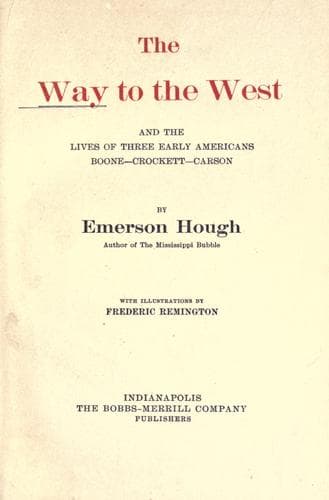
The Way to the West, and the Lives of Three Early Americans: Boone—Crockett—CarsonHough, Emerson
History
The Way to the West, and the Lives of Three Early Americans: Boone—Crockett—Carson
Hough, Emerson
Boone, Daniel, 1734-1820; Carson Kit, 1809-1868; Crockett, Davy, 1786-1836; Mississippi River Valley -- History; West (U.S.) -- History
The other overland trail, and the greatest of all American roads, if we
measure length and importance as well, was the ancient Oregon trail up
the Platte, over the South Pass and down the Columbia; a trail forgotten
by most of the young men of to-day, and existing no more to terrify the
young women whom young men marry, as they did in the times of our
fathers, when moving West meant tearing out the heart.
As to the theory of straight lines, Lieutenant Pike tells us that the
first men to reach Santa Fé did not go straight westward, but also
wandered up the aboriginal highway of the Platte valley, over what was
later to be the course of the Oregon trail, turning to the southward
when far up the stream, and following the South Fork of the Platte down
into the Rockies, which would bring the traveler within wilderness-touch
of the Spanish settlements. La Lande, the perfidious trader, who so
sadly left in the lurch his patron, the merchant Morrison of Kaskaskia,
and took up his permanent abode in Santa Fé, is thought to have reached
that city, in the year 1804, by this route; and it is known that James
Purcell (or James Pursley, as Pike has the spelling) was directed to
Santa Fé in the year 1805 by some Indians whom he met on the upper
Platte.
This route by the Platte was not, however, either the permanent or the
original one. Indeed, the first expedition between the Spanish and the
American settlements came, strangely enough, from the west, and not from
the east, and was undertaken by the Spaniards as early as 1720. Then, in
1739, the Mallet brothers, Frenchmen from the settlements along the
Mississippi, started for New Mexico by the strange route of the upper
Missouri River, getting far up into the big bend of the Missouri before
they discovered that they were going quite the wrong way! Their belief
that the Spanish settlements could be reached by way of the head streams
of the Missouri is strange confirmation of our doctrine that early
traveling man ever clung to the waterways. The river—it would lead
anywhere! The Mallet party returned in 1740, some of them by way of the
Arkansas River, which presently brought them out at New Orleans!
We may therefore discover that neither the Missouri nor the Platte could
have been called the accepted highway into the lower West at the time
Lieutenant Pike set out to find the headwaters of the Red River. There
is a shrewd doubt as to Pike’s innocence in getting over on the head of
the Rio Grande instead of the Red River. It was at least a lucky
mistake; and his captivity among the Spaniards was productive of very
good results to the United States later on, one of its most important
results being his suggesting the route along the Arkansas, instead of
the Platte, for the west-bound travelers. It was strong-legged,
stout-hearted Zebulon who told of the profits of the possible Spanish
trade, and credit is usually given him for first outlining the historic
trail along the Arkansas.
Public-domain text, read in full here on John Shaqi.
Reviews
Reviews
No reviews yet
Be the first to share your thoughts on this work.
Elsewhere in the archive
Join the Discussion
Join the discussion
Sign in to leave a comment or review.
Sign InorCreate an account