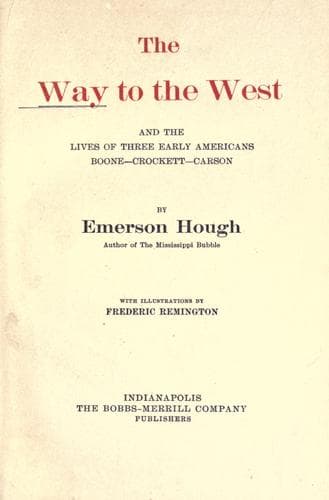
The Way to the West, and the Lives of Three Early Americans: Boone—Crockett—CarsonHough, Emerson
History
The Way to the West, and the Lives of Three Early Americans: Boone—Crockett—Carson
Hough, Emerson
Boone, Daniel, 1734-1820; Carson Kit, 1809-1868; Crockett, Davy, 1786-1836; Mississippi River Valley -- History; West (U.S.) -- History
It grew shorter and shorter, this wagon trail to the West, as the
traders came to know the country. The government surveyed a fine way for
the caravans, which took them around the dangerous Cimarron desert, and
clung to the waters a trifle longer; yet the travelers would have none
of it, but built their trail so direct from Independence to Santa Fé
that not even those air-line lovers, the railway engineers, could so
very much improve it when they came to make their iron trail between
those two points.
One finds something uncanny when he reflects upon the discoveries of
these Western regions. The ancient ways seem to have lain ready and
waiting, the lines of travel simply falling into the foreordained plan,
so that there remains no extraordinary credit to any venturer, no matter
how early. For instance, we know that our hardy young soldiers, Lewis
and Clark, to whom we habitually ascribe the credit of being the first
white men up the great waterway of the Missouri, were preceded by half a
century by the Frenchman, Sieur de la Verendrye, who took his two sons
and started west by way of the Great Lakes in 1742, jumped from the Red
River of the North to the Mandan villages on the Missouri, and explored
the region along the Missouri, the Yellowstone and the Bighorn rivers,
just one hundred years before Frémont “discovered” the Rockies!
De la Verendrye is thought to have been the first man of the North to
see the Rockies; yet back of him we have Nicollet and Champlain, and all
those hardy ancients who sought cheerfully and hopefully for the China
Sea by way of the Green Bay portage, and the Wisconsin and Minnesota
rivers, in search of the fabled “Asian Strait,” which later was
practically materialized in the interlocking Western rivers of America.
As to Pike’s journey across the plains, we must know that the Spaniards
had sent out an expedition, under Malgares, to meet him or anticipate
him. The Spanish leader who thus ventured boldly so far to the east to
head off this dreaded invasion of the Northern whites, and to set the
Indians against them, must have traveled somewhat along this same
pre-ordained trail of the Arkansas. Not all Spain could keep the feet of
the young Anglo-Saxons out of that trail. There were always the
adventurers; and there were always the trails there, ready, waiting,
expectant, prepared for them. There is no reading so thrilling as the
bare truth about our West; and the most thrilling part of it is the
awesome feeling that our venturers were after all themselves but puppets
in a grim and awful game. There lay the Missouri, the Platte, the
Arkansas; and stretching out to meet them reached the Columbia and the
Colorado. It was appointed, it was foregone!
Public-domain text, read in full here on John Shaqi.
Reviews
Reviews
No reviews yet
Be the first to share your thoughts on this work.
Elsewhere in the archive
Join the Discussion
Join the discussion
Sign in to leave a comment or review.
Sign InorCreate an account