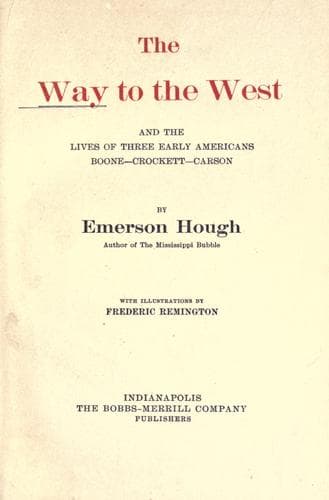
The Way to the West, and the Lives of Three Early Americans: Boone—Crockett—CarsonHough, Emerson
History
The Way to the West, and the Lives of Three Early Americans: Boone—Crockett—Carson
Hough, Emerson
Boone, Daniel, 1734-1820; Carson Kit, 1809-1868; Crockett, Davy, 1786-1836; Mississippi River Valley -- History; West (U.S.) -- History
“As to the expedition of Baird, Chambers and McKnight, it is often
spoken of as that of ‘McKnight, Beard and Chambers.’ Gregg, in his book
‘The Commerce of the Prairies,’ published in 1846 (I think), first
mentioned the matter. He derived his information from James Baird’s
sons, and they were much disgusted to have him print the name ‘Beard.’
All other writers seem to have derived their particulars from him. James
Baird was my grandfather. He was personally known to Lieut. Zebulon
Pike, had known him at Fort Duquesne and at Erie. Baird went to St.
Louis in 1810, where he again met Lieutenant Pike upon his return from
Mexico, and learned from him the possibilities of trade with that
country.
“Upon hearing of the success of the Hidalgo revolution, and believing
the embargo upon trade with the United States raised, he organized a
venture with Chambers and McKnight, left St. Charles, Mo., May 1, 1812,
and reached Santa Fé in regular course, to find the embargo rigorously
enforced. He was arrested and imprisoned in Chihuahua prison for nine
years and three months, until released by Iturbide in 1821. Chambers and
McKnight started back at once. McKnight was killed by the Indians on the
Arkansas River. Chambers succeeded in getting back to St. Louis. Baird
started back two months later, could find no company, and rode alone
from Santa Fé to St. Louis. This ride has been credited to Bicknell and
one Kennedy or Kendall, but James Baird was the man that did it.
“Baird and Chambers organized a second expedition in 1822. They started
too late, and were caught in a blizzard at the crossing of the Arkansas,
where their animals froze to death. They were compelled to remain the
entire winter upon the island at that place. It was Baird and Chambers’
second expedition that made the caches near there (in 1822), and near
where Dodge City now stands. Inman in his ‘Old Santa Fé Trail,’ chapter
3, says Bicknell[33] crossed the river at the Caches in 1812. No other
caches were made in that vicinity. Bicknell was a trader with the Iatan
Indians and did not go into Mexico until after Baird and Chambers’
second venture, which was made in 1822. However, it was through some of
Bicknell’s men writing from Franklin, Mo., to my grandmother, in 1816,
that she learned of grandfather’s fate, they saying that they heard of
it from the Indians.
“Baird, Chambers and McKnight followed the course marked for them by
Lieutenant Pike, and that course became the great Santa Fé trail. The
Atchison, Topeka & Santa Fé R. R. follows practically the same course.
If any one is entitled to credit for the selection of the route,
Lieutenant Pike ought to have it. However, my purpose is to ask you to
correct the name Beard to read Baird. If one will refer to ‘American
State Papers,’ Vol. 4, folio 207, and Executive Papers, p. 197, 8th
Vol., 15th Congress, he will see that it is Baird.”
Public-domain text, read in full here on John Shaqi.
Reviews
Reviews
No reviews yet
Be the first to share your thoughts on this work.
Elsewhere in the archive
Join the Discussion
Join the discussion
Sign in to leave a comment or review.
Sign InorCreate an account