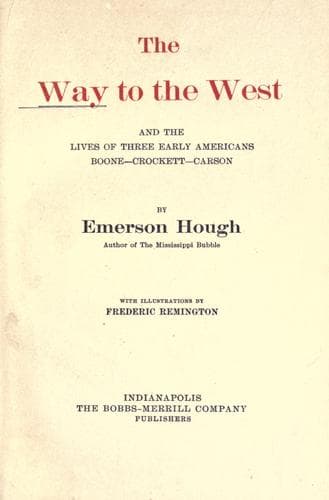
The Way to the West, and the Lives of Three Early Americans: Boone—Crockett—CarsonHough, Emerson
History
The Way to the West, and the Lives of Three Early Americans: Boone—Crockett—Carson
Hough, Emerson
Boone, Daniel, 1734-1820; Carson Kit, 1809-1868; Crockett, Davy, 1786-1836; Mississippi River Valley -- History; West (U.S.) -- History
This communication would seem to a certain extent to discount the claims
on reputation of William Becknell, generally known as the “father of the
Santa Fé trail.” It ascribes the credit for the original selection of
the Arkansas River route to Pike, with what justice we may ourselves
determine as well as any. Our venturesome Southerners, of the Baird,
McKnight and Chambers party, had lain in jail for nine years before John
McKnight, the brother of Robert McKnight, in the year 1821, undertook
the long journey to Chihuahua, which seems to have resulted in the
setting free of all these Americans. Coming back to the United States
over the Arkansas River trail, Baird and the two McKnights met the Ohio
man, Hugh Glenn, and his associate or friend, Jacob Fowler, who were
already at Taos, regardless of the ill-fortune of their predecessors in
the hazardous game of prairie commerce. Becknell himself did not start
out until 1821, and he did not intend to trade in Santa Fé, but only
went thence after he had met some Mexicans on the headwaters of the
Arkansas, who persuaded him to take his goods to Santa Fé instead of
trading them among the Indians. Hugh Glenn and Becknell were thus both
at Santa Fé during the winter of 1821-22.
That following summer Braxton Cooper and his sons, as well as Becknell,
made trips to Santa Fé, and it seems to have been on this second trip
that Becknell attained the distinction commonly accorded him. He took
three wagons through to Santa Fé, and instead of hugging the Arkansas
clear out to the mountains, he struck off southwest toward San Miguel,
by way of the Cimarron desert, the risky but shorter route to which the
later traders adhered ever after, in spite of surveys and all else. It
is really only upon the ground of his wagons and this cutoff angle that
Becknell is entitled to the glory of his title as “father of the Santa
Fé trail.”
Our prisoners, who nine years before had taken the chance of the far-off
Southwestern trade, were willing to take another chance, for no sooner
had they reached the States than they outfitted and started back again
for the Mexican trade. Their second party, that which made the famous
caches referred to in the grandson’s letter above, was made in 1822. By
that time there was little glory left for any one; and indeed, when we
come to sift it, there was never very much glory in any part of the
history of the Santa Fé trail. It was not a pathway of heroes. The true
hero trail lay farther to the north, as we shall presently see.
Public-domain text, read in full here on John Shaqi.
Reviews
Reviews
No reviews yet
Be the first to share your thoughts on this work.
Elsewhere in the archive
Join the Discussion
Join the discussion
Sign in to leave a comment or review.
Sign InorCreate an account