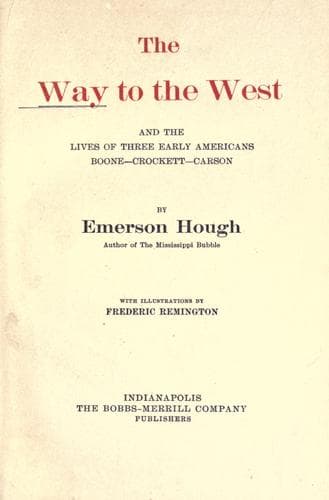
The Way to the West, and the Lives of Three Early Americans: Boone—Crockett—CarsonHough, Emerson
History
The Way to the West, and the Lives of Three Early Americans: Boone—Crockett—Carson
Hough, Emerson
Boone, Daniel, 1734-1820; Carson Kit, 1809-1868; Crockett, Davy, 1786-1836; Mississippi River Valley -- History; West (U.S.) -- History
In 1836 there occurred a great and wonderful thing. Two women moved out
into the West along the Oregon trail. We keep record of the times when
wagons first went up the Platte, and we shall do well also to note this
date of 1836, when women of the white race first went over the national
road of the West. These two were the wives of Whitman and Spalding,
missionaries bound for Oregon. Father de Smet, great man and good, a
missionary also, followed in 1840; then more missionaries from New
England—always prolific of missionaries; and two years later Frémont,
as far at least as the South Pass. Then came the Mormons in 1847, bound
for their kingdom of Deseret, and the Oregon Battalion in the same year;
these followed soon thereafter by a continuous stream made up of
thousands of trappers and explorers and visitors and gold seekers, who
began to crowd West after ’49 and the discovery of gold. Those were busy
times in the West, we may be sure. The Oregon trail grew deep and wide.
No traveler on the north and south line could cross it without being
aware of that fact. It was the plain, main-traveled road.
The first agricultural invasion along the old trail might be said to be
that of the Mormons, who sent delegations from their settlements to
occupy the Green River valley, and who used the trail for a short way.
General Albert Sidney Johnston used it for many more miles, when he went
out to take care of some of these Mormons, now grown obstreperous.
Even so late as this we are many years in advance of the railways; which
indeed do not even to-day occupy the old Oregon trail throughout its
entire length, though using much of it on both sides of that easy South
Pass country, once so useful to the trappers and wagon travelers, but
not so essential to railway engineers looking for more direct lines
across the wastes. Perhaps we shall some day see a line of rails follow
throughout the two thousand miles of this ancient trail. Even so, our
American tourists would still go to Europe in search of ruins and
history and memories! We know and care all too little now for this old
trail, whose earliest travelers were called by the California Indians
the “Whoa-haws”—that being the word most used by the aforesaid
emigrants, who had pushed their ox-teams across half a continent.
Significant term, this “Whoa-haw” title, though we have now forgotten
it.
The emigrants of to-day do not go by the “Whoa-haw” route. On February
twelfth of the year 1902, between fifteen hundred and eighteen hundred
land hunters left the city of Chicago for the country of the Northwest.
Two-thirds of these came from the crowded East, the remaining third, for
the most part, from the crowded West of Illinois, Indiana and Wisconsin,
now grown very old.
Public-domain text, read in full here on John Shaqi.
Reviews
Reviews
No reviews yet
Be the first to share your thoughts on this work.
Elsewhere in the archive
Join the Discussion
Join the discussion
Sign in to leave a comment or review.
Sign InorCreate an account