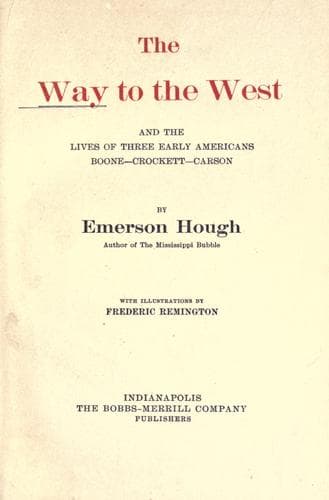
The Way to the West, and the Lives of Three Early Americans: Boone—Crockett—CarsonHough, Emerson
History
The Way to the West, and the Lives of Three Early Americans: Boone—Crockett—Carson
Hough, Emerson
Boone, Daniel, 1734-1820; Carson Kit, 1809-1868; Crockett, Davy, 1786-1836; Mississippi River Valley -- History; West (U.S.) -- History
So practicable was this post of Fort Laramie, and so practicable also
the route on which it was located, that in 1849 the United States
government bought the old post, and used it as a military establishment,
so adding to its long and exciting history. Eight years after the
building of Fort Laramie, Fort Bridger was built by Jim Bridger, on a
branch of the Green River, over the Divide, farther out to the west,
along what had now come to be a universally accepted highway.
Jim Bridger, possibly the first discoverer of Great Salt Lake, was, by
the year 1842, ready to admit that the old days were over and done with.
No more trapping for Jim Bridger. The West was gone. He must thenceforth
feed Mormons, or guide government officers in their “explorations.”
Bridger gave up the West as a squeezed orange at just the time Frémont
was starting out to make his name as the “Pathfinder” of the Rockies.
Frémont, and all the other explorers of so late a period, went west as
far as the head waters of the Green River over the Oregon trail,—a road
a man could have followed in the dark.
The Mormons took over Fort Bridger in 1853, not liking so stable a
Gentile institution thus near to their realm; but the Mormons forgot
that they could not wipe out the trail that led to Bridger’s old log
fortress. The trail brought on an ever-growing stream of travel. In time
Fort Bridger, too, became an army post, and remained such from 1857 till
1890. Since the latter date it has been abandoned. We go to Europe to
seek for interesting ruins, forgetting Laramie and Bridger and Benton,
all spots with significant and thrilling histories.
As to the great trail of the Northwest, considered as a transcontinental
trail properly so called, its second stage might be said to begin in
1834,[38] when it was first used as a route straight through to Oregon.
After that date the parties of emigrants steadily grew in numbers, among
them not only men from Missouri, but farther to the east.
Public-domain text, read in full here on John Shaqi.
Reviews
Reviews
No reviews yet
Be the first to share your thoughts on this work.
Elsewhere in the archive
Join the Discussion
Join the discussion
Sign in to leave a comment or review.
Sign InorCreate an account