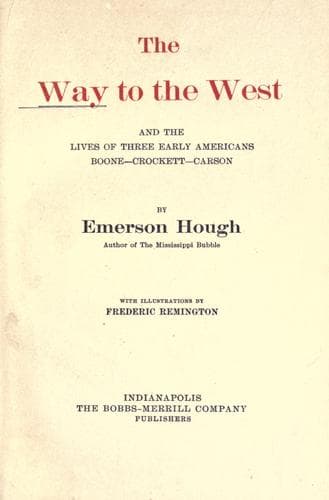
The Way to the West, and the Lives of Three Early Americans: Boone—Crockett—CarsonHough, Emerson
History
The Way to the West, and the Lives of Three Early Americans: Boone—Crockett—Carson
Hough, Emerson
Boone, Daniel, 1734-1820; Carson Kit, 1809-1868; Crockett, Davy, 1786-1836; Mississippi River Valley -- History; West (U.S.) -- History
Parkman states in the preface to a later edition of his work (1872): “We
knew that a few fanatical outcasts were groping their way across the
plains to seek an asylum from Gentile persecution, but we did not dream
that the polygamous hordes of Mormon would rear a swarming Jerusalem in
the bosom of solitude itself. We knew that, more and more, year after
year, the trains of the emigrant wagons would creep in slow procession
toward barbarous Oregon or wild California, but we did not dream, how
Commerce and Gold would breed nations along the Pacific, the
disenchanting screech of locomotives break the spell of weird mysterious
mountains. . . . The wild cavalcade that defiled with me down the gorges
of the Black Hills, with its paint and war plumes, fluttering trophies
and savage embroidery, bows, arrows, lances and shields, will never be
seen again.”
In no way could Parkman have been more just or thoughtful than in one of
his chance statements. “All things are relative,” said he. “The West is
either very old or very new, according as we look at it.” From the one
point of view he might feel a superiority of his own, for as he traveled
over the country a few days’ march west of Leavenworth he saw many
antlers of elk and skulls of buffalo, “reminders of the animals once
swarming over this now deserted region.” This intervening country
between the Missouri River and the plains proper he considers to serve
the popular notion of the “prairie.” “For this it is,” he writes, “from
which tourists, painters, poets and novelists, who have seldom
penetrated farther, derived their conception of the whole region.” There
was fell stroke of unwitting justice! Even to-day there are artists and
novelists that deal with the West, but have “seldom penetrated farther”
than the edge of the real West.
Public-domain text, read in full here on John Shaqi.
Reviews
Reviews
No reviews yet
Be the first to share your thoughts on this work.
Elsewhere in the archive
Join the Discussion
Join the discussion
Sign in to leave a comment or review.
Sign InorCreate an account