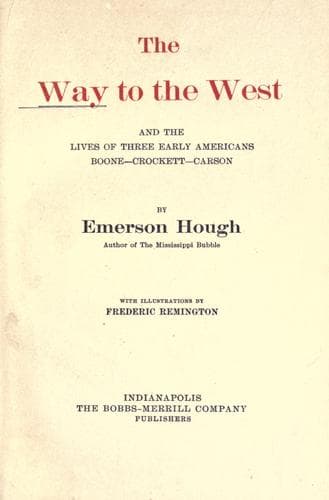
The Way to the West, and the Lives of Three Early Americans: Boone—Crockett—CarsonHough, Emerson
History
The Way to the West, and the Lives of Three Early Americans: Boone—Crockett—Carson
Hough, Emerson
Boone, Daniel, 1734-1820; Carson Kit, 1809-1868; Crockett, Davy, 1786-1836; Mississippi River Valley -- History; West (U.S.) -- History
Parkman himself saw the old trail fairly well dotted with the outfits of
the west-bound emigrants. He describes the difficulties then existing
between the Mormons and their enemies, and the suspicions of the one
party against the other. He saw one party of fifty wagons, with
“hundreds of cattle,” on his way up the Platte. Far out to the West, on
that Horse Creek so frequently mentioned in the history of the mountain
trappers’ rendezvous, he witnessed a party of Indian women and children
bathing in the stream, while meantime “a long train of emigrants with
their heavy wagons was crossing the creek, and dragging on in slow
procession by the encampment of the people whom they and their
descendants, in the space of a century, are to sweep from the face of
the earth.” This was toward the headwaters of the Platte, of course, not
far from that Fort Laramie where he met the grandsons of Daniel Boone,
still going West, even unto the third and fourth generation. “Great
changes are at hand,” says he, “great changes are at hand in all that
region. With the stream of emigration to Oregon and California the
buffalo will dwindle away. . . . In a few years the traveler will pass
in tolerable security.” This was the utmost prophecy of one of the most
intelligent and philosophical travelers that ever went from the East
into the West!
Yet one of the most vivid conceptions possible of the history of that
day, as bearing on the strange impulse that seemed to drive these
wanderers west and ever westward, may be gained from a passage of
Parkman’s “Oregon Trail.” “It is worth noticing,” says he, “that on the
Platte one may sometimes see the shattered wrecks of ancient claw-footed
tables, well waxed and rubbed, or massive bureaus of carved oak. These,
some of them no doubt the relics of ancestral prosperity in colonial
times, must have encountered strange vicissitudes. Brought, perhaps,
originally from England; then, with the declining fortunes of their
owners, borne across the Alleghanies to the wilderness of Ohio or
Kentucky; then to Illinois or Missouri; and now at last fondly stowed
away for the interminable journey to Oregon. But the stern privations of
the way are little anticipated. The cherished relic is thrown out to
scorch and crack on the hot prairie.” What a world of suggestion there
lies in this chance picture of the desert—what a world of American
history it covers! Perhaps one day the American people will come to take
interest in a past so curious and so striking as its own.
Public-domain text, read in full here on John Shaqi.
Reviews
Reviews
No reviews yet
Be the first to share your thoughts on this work.
Elsewhere in the archive
Join the Discussion
Join the discussion
Sign in to leave a comment or review.
Sign InorCreate an account