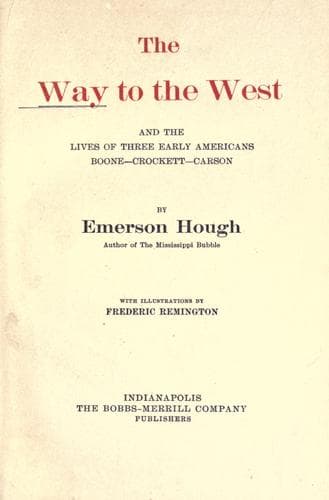
The Way to the West, and the Lives of Three Early Americans: Boone—Crockett—CarsonHough, Emerson
History
The Way to the West, and the Lives of Three Early Americans: Boone—Crockett—Carson
Hough, Emerson
Boone, Daniel, 1734-1820; Carson Kit, 1809-1868; Crockett, Davy, 1786-1836; Mississippi River Valley -- History; West (U.S.) -- History
At the Raft River was another point of great interest; for here turned
aside the arm of the transcontinental trail that led to California. This
fork of the road was thirteen hundred and thirty-four miles from the
Missouri.[42] Working as best it might from the Raft River, down the
Great Snake valley, touching and crossing and paralleling several
different streams, the trail ran until it reached the Grande Ronde
valley, at the eastern edge of the difficult Blue Mountains, and
seventeen hundred and thirty-six miles from the starting point. The
railway to-day crosses the Blues where the old trail did. Then the route
struck the Umatilla, and shortly thereafter the mighty Columbia, the
“Oregon” of the poet, and a stream concerning which we were not always
so placid as we are to-day. It was nineteen hundred and thirty-four
miles to the Dalles, nineteen hundred and seventy-seven miles to the
Cascades, two thousand and twenty miles to Fort Vancouver, and
twenty-one hundred and thirty-four miles to the mouth of the Columbia;
though the trail proper terminated at Fort Vancouver—the same post, as
we shall see, for which the hero Jedediah Smith headed when he was in
such dire distress, in the mountains of southwest Oregon.[43]
This was the way to the Pacific, the trail across the Rockies, the
appointed path of the heroes that ventured forth into the unknown lands,
as well as of the men that followed them safely in later days. It was
but a continuation of the way to the Missouri, of the way across the
Alleghanies, a part of the path of the strange appointed pilgrimage of
the white race in America.
-----
Footnote 36:
Said to have been the first white man to cross the borders of what is
now Wyoming.
Footnote 37:
Again our useful date of 1834.
Footnote 38:
Pray you yet again, remember this great American date of 1834, and you
shall be quit of all others, all those telling of wars and politics.
That was the year when the beaver trapping ceased to be profitable,
when the trappers came in, when the wild West began to become the
civilized West. This date, remembered philosophically, will prove of
the utmost service in retaining a connected idea of the settlement of
the West. It has bearings both upon the past and upon the future. It
is a milestone marking the parting of the ways.
Footnote 39:
One of Parkman’s men, the hunter Raymond, perished in the ill-fated
Frémont third expedition, among the snows of the lofty mountains far
below the South Pass.
Footnote 40:
V. also Chapter II, Vol. III; “The Santa Fé Trail.”
Footnote 41:
Footnote A: Chittenden.
Footnote 42:
The later California trail passed farther to the south, along the
upper end of the Great Salt Lake, leaving the main trail at the upper
bend of the Bear, to the east of Fort Hall.
Footnote 43:
V. Chapter IV, Vol. III; “Early Explorers of the Trans-Missouri.”
CHAPTER IV
Public-domain text, read in full here on John Shaqi.
Reviews
Reviews
No reviews yet
Be the first to share your thoughts on this work.
Elsewhere in the archive
Join the Discussion
Join the discussion
Sign in to leave a comment or review.
Sign InorCreate an account