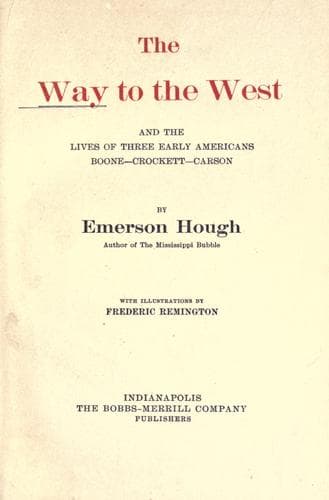
The Way to the West, and the Lives of Three Early Americans: Boone—Crockett—CarsonHough, Emerson
History
The Way to the West, and the Lives of Three Early Americans: Boone—Crockett—Carson
Hough, Emerson
Boone, Daniel, 1734-1820; Carson Kit, 1809-1868; Crockett, Davy, 1786-1836; Mississippi River Valley -- History; West (U.S.) -- History
If we go by dates alone we shall find ourselves presently concerned with
Captain Bonneville, sometime famous as an “explorer” of the Rocky
Mountains. Him we may class as one of the pseudo-discoverers. He was an
army officer, who discovered nothing, but who obtained a great
reputation through the chronicling of his deeds in the Rocky Mountains;
so great that, having grossly exceeded his leave of absence, he was
eventually reinstated in the Army after he had lost his commission, the
president of the United States remarking that he “could not fail so to
reward one who had contributed so much to the welfare of his country”!
Bonneville was a lucky man. He lost but few mules and but few men. He
brought back a map on which was founded the greater part of his
reputation, maps and scientific nomenclature having been ever, in the
estimation of some, held to surpass any original discoveries in
geography and natural history.
Bonneville’s map had a certain value at the time, yet it held little
actual first hand information, because it was built upon knowledge
derived from Gallatin, from that big man, General Ashley, the fur
trader, and from the latter’s gallant associate, Jedediah Smith.[44] As
to Bonneville himself, he was, unless we shall except Frémont, the first
great example of the class later to be known as “tenderfoot.” A certain
glory attaches to him, because he was the first man to take a wagon
train through the South Pass, which he did ten years before Frémont
“discovered” that country.
Bonneville went West in 1832, two years before Kit Carson stopped
trapping beaver for the reason that it no longer paid him. The lucky
captain traveled up the Platte valley to Fort Laramie, then broke across
on the old mountain road of the West, up the Sweetwater, to the South
Pass, thence getting upon the Pacific waters, the headwaters of the
Green River; one of the two great arms of the Colorado, and an important
stream in fur trading days. Obviously, Bonneville wanted to grow rich
quickly in the fur trade, being more intent on that than on exploration
for geographical purposes. He discovered that there was already a West
beyond him, even then a distinct region, with ways of its own and men of
its own. He continued to move about in the mountains for a couple of
years more, the South Pass serving as the center of his operations; but
really it is of little concern what Bonneville did during the remainder
of his long stay in the West. We may, none the less, after a fashion,
call Bonneville one of the predecessors of Carson, if we shall date
Carson’s earthly existence only from his connection with Frémont. How,
then, did the lucky captain indirectly serve as predecessor of quiet and
valid Kit Carson?
Public-domain text, read in full here on John Shaqi.
Reviews
Reviews
No reviews yet
Be the first to share your thoughts on this work.
Elsewhere in the archive
Join the Discussion
Join the discussion
Sign in to leave a comment or review.
Sign InorCreate an account