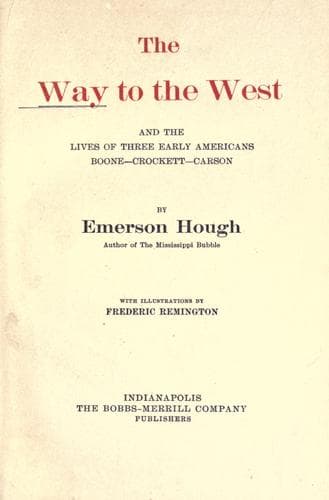
The Way to the West, and the Lives of Three Early Americans: Boone—Crockett—CarsonHough, Emerson
History
The Way to the West, and the Lives of Three Early Americans: Boone—Crockett—Carson
Hough, Emerson
Boone, Daniel, 1734-1820; Carson Kit, 1809-1868; Crockett, Davy, 1786-1836; Mississippi River Valley -- History; West (U.S.) -- History
It was in this way. Bonneville had with him an old Santa Fé trail man
named J. R. Walker; for we must remember that in 1832 the Santa Fé trail
had really seen its best days. Walker wanted to go to California, and
Bonneville was eager to have him do so, for the worthy captain was far
more concerned about beaver than about geography; and there was, as we
shall presently discover, a very good reason to foresee an abundance of
beaver in California. Bonneville and his lieutenant, when these plans
first matured, were still on the Green River, this being the year after
they had first reached the Rockies. The fur trade was not prosperous;
even thus early they found competition in the Rocky Mountains. The
country was not new enough. The West, as viewed from the headwaters of
the Green River, lay still farther forward in the course of the setting
sun. Walker must go to California and bring back from it its beaver
peltry.
Walker, therefore, on July twenty-seventh, 1833, left Bonneville on the
Green River and started on the tremendous journey toward the Pacific
Ocean. He took with him forty men, and perhaps later picked up a dozen
wandering trappers or so, who desired to join the California venture.
Here, then, was a discoverer who started for California more than a
decade before Frémont did; more than sixteen years before any one
suspected California to be a land of gold. The trapping of beaver, and
not the digging of gold, was the first cause of Californian exploration
by the Americans of the upper West. The beaver was a fateful animal.
Walker dropped down the Green River into the valley of the Great Salt
Lake, which was at that time a perfectly well known country, though it
had not been described in any official reports. Thence he headed
westward across the Great Basin, whose terrors had so long held back
even the hardy trappers of the mountain region. He gave the name Barren
River to the stream now called the Humboldt. He gave his own name to
another stream. After some fashion he won across the great desert, and
crossed also the Sierra range, accomplishing this latter feat about
October twenty-fifth. He was, perhaps, the first man to see the Yosemite
valley, though as to that we can not be certain. By the end of November,
1833, he was within view of the Pacific Ocean.
After all, then, it did not seem to be so hard to get across the country
in those early times. Nor was it so difficult to return. Walker had
fifty-two men and three hundred and sixty-five horses when he started
eastward in February, 1834. He had, of course, met that Spanish
civilization which first explored the Colorado River and first settled
the Pacific slope. Walker now had guides, Indians of the land, who led
him eastward across the Sierras, somewhat south of the place where he
crossed going west.
Public-domain text, read in full here on John Shaqi.
Reviews
Reviews
No reviews yet
Be the first to share your thoughts on this work.
Elsewhere in the archive
Join the Discussion
Join the discussion
Sign in to leave a comment or review.
Sign InorCreate an account