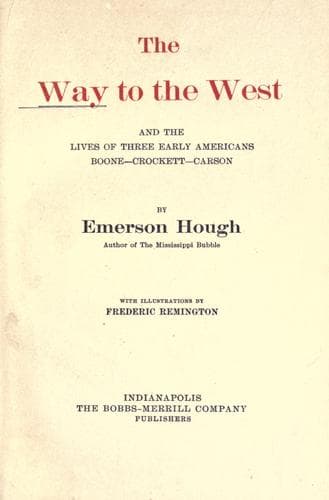
The Way to the West, and the Lives of Three Early Americans: Boone—Crockett—CarsonHough, Emerson
History
The Way to the West, and the Lives of Three Early Americans: Boone—Crockett—Carson
Hough, Emerson
Boone, Daniel, 1734-1820; Carson Kit, 1809-1868; Crockett, Davy, 1786-1836; Mississippi River Valley -- History; West (U.S.) -- History
We are getting close to the first of new-American things when we come to
the story of his journey. There had been early Spaniards, there had been
Indians perhaps, who knew the way across, but there was none to pilot
Smith. He started of his own resolve and traveled under his own
guidance. They had not told him, as they had told Kit Carson, of the
excellent beaver country of the Sacramento. The vast country beyond the
Great Salt Lake had been too forbidding for even that later hardy soul
to undertake as yet; and the reaches of the Rockies above and below the
eastern edge of that desert had contented all of Bridger’s hardy
companions. The more reason, therefore, thought Smith, that he and his
little party of fifteen men should cross the desert; and he did so,
quite as though it were a matter of course.
Having no guide, he simply went west as well as he could, clinging to
grass and water as he went. He left the rendezvous near Salt Lake in
1826, crossed the Sevier valley, struck the Virgin or Adams River,
followed the Colorado for a time, and at length broke boldly away over
the awful California desert, until, in such way as we can but imagine,
he reached at length the Spanish settlements of San Diego. This was in
the month of October. Smith crossed the Sierras near the point where
runs to-day the Atchison, Topeka and Santa Fé Railroad. He was somewhat
in advance of the engineers.
Although we do not learn that Smith had any guide or any advance
information, it seems that the Spaniards did not appreciate the
difficulties under which he had visited them. They bade him leave the
country at once. Perhaps Smith was not quite candid with the Spaniards,
for, though he promised compliance, instead of starting directly back to
the eastward, he went north four hundred miles, put out his traps and
wintered on the San Joaquin and Merced rivers. He found there a
trapper’s El Dorado.
This information, of course, would be more valuable when imparted to his
friends eastward in the Rockies. Hence we observe Smith leaving his
party, and taking with him only two men, seven horses and two mules,
calmly starting back again to the Rockies, which by this time must have
seemed to him an old and well settled country. In the incredible time of
twenty-eight days he was back again at the southwest corner of Salt
Lake. We can not tell just how he made this journey. Perhaps he crossed
the Sierras near the Sonora Pass, thence went east, far to the south of
the Humboldt River, and south also of what is now called Walker Lake. We
must remember that neither this river nor lake had any name when Smith
was there. Jedediah Smith antedated all names, all maps, all geography!
Yet all this was not so very long ago, if we reflect that it took three
hundred years to find the source of the Mississippi River after its
mouth had been discovered. It is not yet one hundred years back to
Smith.
Public-domain text, read in full here on John Shaqi.
Reviews
Reviews
No reviews yet
Be the first to share your thoughts on this work.
Elsewhere in the archive
Join the Discussion
Join the discussion
Sign in to leave a comment or review.
Sign InorCreate an account