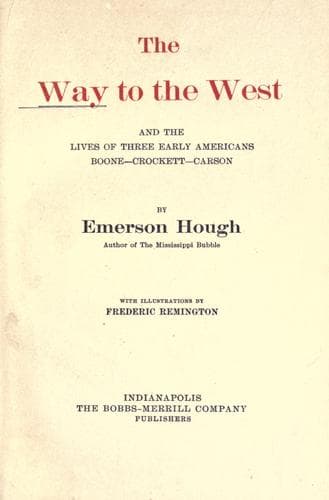
The Way to the West, and the Lives of Three Early Americans: Boone—Crockett—CarsonHough, Emerson
History
The Way to the West, and the Lives of Three Early Americans: Boone—Crockett—Carson
Hough, Emerson
Boone, Daniel, 1734-1820; Carson Kit, 1809-1868; Crockett, Davy, 1786-1836; Mississippi River Valley -- History; West (U.S.) -- History
Jedediah Smith was no man to waste time. He told his friends what he had
found beyond the snowy range. By July thirteenth, 1827, he was ready
with eighteen men of a new party to start back for California. Now he
began to meet the first of his extraordinarily bad luck, the first of a
series of misfortunes that must have stopped any man but himself. The
Spaniards seem to have had some notion of Smith’s intentions, and they
set Indians to watch the trails down the Virgin and the Colorado. These
met Smith near the Colorado River and killed ten of his men. Almost
destitute, Smith reached the Spanish settlements of San Gabriel and San
Diego only to meet with further misfortune. His native guides—for now
he had learned how to secure Indian guides—were imprisoned, and he
himself was thrown into jail at San José. He was released on condition
that he leave the country; which he proceeded to do after a fashion
peculiarly his own. He traveled three hundred miles to the north and
wintered on a stream now called, from that fact, the American Fork.
All this time he was finding good beaver country, and the packs of the
little party grew heavier and heavier. Why he did not now cross the
Sierras and get back home again we do not know; but instead of going
east, he struck northwest, until he nearly reached the Pacific Ocean.
Thence he turned inland, and headed due north,—which meant Oregon. It
is easy to-day, but Smith had no map, no trail, no transportation save
that of the horse and mule train. All the time he and his party
continued to pick up a greater store of beaver.
At last, on July twenty-fourth, 1828, somewhere near the Umpqua River,
they established a temporary camp. On that day Smith left camp for a
time, and as he returned he met Indians, who fired upon him. He got back
to the bivouac, only to find it the scene of one of those horrible
Indian butcheries with which the trapper of that day was all too
familiar. Ten men out of his new party had been killed on the Colorado.
Here, about the camp in Oregon, lay fifteen more of his men, dead,
scalped and mutilated. The horses were gone. Three of his companions had
escaped, but these had fled in a panic, each on his own account. The
discoverer, Smith, was there alone in the mountains, without map,
without guide, without counsel. There was a situation, simple, primeval,
Titanic! There indeed was the West!
Public-domain text, read in full here on John Shaqi.
Reviews
Reviews
No reviews yet
Be the first to share your thoughts on this work.
Elsewhere in the archive
Join the Discussion
Join the discussion
Sign in to leave a comment or review.
Sign InorCreate an account