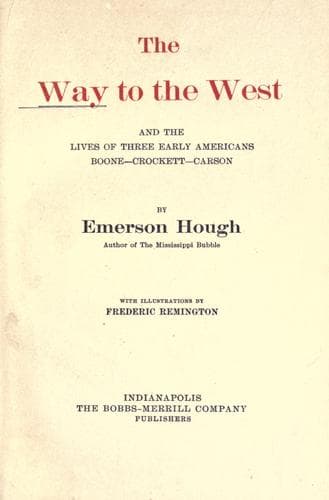
The Way to the West, and the Lives of Three Early Americans: Boone—Crockett—CarsonHough, Emerson
History
The Way to the West, and the Lives of Three Early Americans: Boone—Crockett—Carson
Hough, Emerson
Boone, Daniel, 1734-1820; Carson Kit, 1809-1868; Crockett, Davy, 1786-1836; Mississippi River Valley -- History; West (U.S.) -- History
It can not accurately be told who first made this trail, crossing the
valley of the Colorado, whose flood drains two hundred and twenty-five
thousand square miles of mountain and desert. In 1781 Father Garcés
built a mission on the Colorado near the mouth of the Gila. But he was
not the first. Cardenas, a fellow-soldier with Coronado, is perhaps the
first man to write of the Grand Cañon of the Colorado; but he was not
the first to discover it nor the first to see that stream. Alarcon, a
member of the party of the sea captain Uloa, was the first man to reach
the Colorado. This was in the year 1540, the ship of Uloa reaching the
Gulf of California in 1539.
This was a small matter of three hundred years before Frémont saw the
South Pass, some three hundred years before Jedediah Smith crossed the
desert to California, and something like three hundred years before the
upper sources of the Mississippi River were known! So thus we may leave
this portion of the West to await the Gadsden Purchase, and the addition
of the land won by Houston and Crockett and Fannin and Travis and other
hero friends to the south and east of the purchased territory.
As for the transportation employed during these early times, we may
repeat a few facts by way of insistence. The Santa Fé trade began with
pack trains, but saw wagons used in 1822. In 1826 General Ashley took
his little wheeled cannon through the South Pass to his fort on Utah
Lake. In 1830 Smith, Sublette and Jackson made the journey from the
Missouri River with mule teams and wagons as far as the Wind River; and
they said they could have gone on over the South Pass with their wagons
had they wished to do so. Poor Bonneville! His distinction of taking the
first wagon through the South Pass is as empty as that of Frémont in
climbing his mountain peak near that same South Pass. Both
accomplishments had been left undone by earlier visitors simply because
they did not want to do these things. We see that, before Carson or
Walker or Smith, the courses and headwaters of the Yellowstone and the
Missouri and the Columbia rivers were all very well known. We have noted
that Smith knew of the Columbia settlements. This he knew because he had
learned it at the rendezvous. How came these settlements on the
Columbia? We shall have to go to New York to find the answer to that
question.
Everybody knows the story of Astoria and the beginning of the American
Fur Company. John Jacob Astor of New York secured a New York charter for
that company April sixth, 1808, very soon after hearing the results of
the Lewis and Clark expedition. He had a great purpose in his mind. He
had fought out and bought out competitors in the fur trade all along the
Great Lakes; had met and gaged the resources of the Northwest Company,
then beginning to rival the ancient Hudson Bay Company in the wild race
across the continent.
Public-domain text, read in full here on John Shaqi.
Reviews
Reviews
No reviews yet
Be the first to share your thoughts on this work.
Elsewhere in the archive
Join the Discussion
Join the discussion
Sign in to leave a comment or review.
Sign InorCreate an account