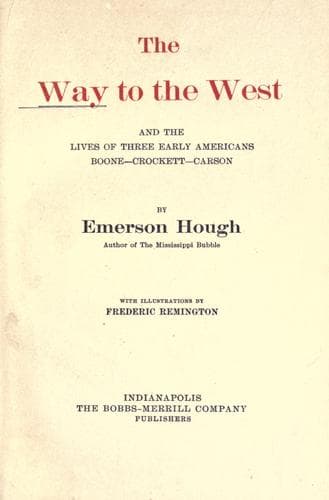
The Way to the West, and the Lives of Three Early Americans: Boone—Crockett—CarsonHough, Emerson
History
The Way to the West, and the Lives of Three Early Americans: Boone—Crockett—Carson
Hough, Emerson
Boone, Daniel, 1734-1820; Carson Kit, 1809-1868; Crockett, Davy, 1786-1836; Mississippi River Valley -- History; West (U.S.) -- History
It was Astor’s idea to beat the Northwest Fur Company to the mouth of
the Columbia, and hence command what was supposed to be the rich fur
trade of that new and unknown region. He intended to send ships laden
with trading supplies to the mouth of the Columbia River, there to take
on the cargoes of furs caught by his own men or secured in trade with
the Indians. These ships, laden with furs, were to go thence across the
Pacific to China, and were to return from China to New York, laden with
the products of the Orient, which our old-time historian, Henry Howe,
thought must some time come across the American continent by rail. Here,
then, was a commercial undertaking of no small dimensions.
Mr. Astor attached two strings to his bow. He fitted out one expedition
by sea, and one by land, the objective point of each being the mouth of
the Columbia River. He relied largely upon men he had known in the fur
trade of the Great Lakes for the leadership of his land party, but he
made the great mistake of placing three men in practically equal
command. Unfortunately, he made another mistake in establishing the
leadership of his sea expedition. There was but one leader there, the
captain of the ship Tonquin, Thorne by name, a man by no means fitted to
command any company of adventurers. The Tonquin left New York September
sixth, 1810. It reached the mouth of the Columbia River March
twenty-second, 1811. A party was soon thereafter detached for the
erection of the proposed post to be known as Astoria. The Tonquin then
proceeded northward up the coast. Its commander, domineering,
overbearing, not fitted to trade with the Indians, succeeded in exciting
the wrath of the Coast Indians. The latter attacked his ship and
practically destroyed his crew, one of whom, an unknown fighting man,
whose name is lost by reason of events, blew up the ship, killing many
savages and destroying all vestige of the encounter. This was about June
thirteenth, 1811.
As to the land party under its three leaders, we may say that the winter
was spent near St. Joseph, Missouri, but on April twenty-first, 1811,
about a month after the ship Tonquin had reached the mouth of the
Columbia, this land party started out on its long and arduous western
journey. By June twelfth they had traveled thirteen hundred and
twenty-five miles up the Missouri River, being then in the neighborhood
of the Arickaree villages. There they bought horses and started boldly
westward, leaving the waterway of the Missouri, the first of the great
companies of transcontinental travelers to proceed along the cord of the
great bow of the Missouri.
Public-domain text, read in full here on John Shaqi.
Reviews
Reviews
No reviews yet
Be the first to share your thoughts on this work.
Elsewhere in the archive
Join the Discussion
Join the discussion
Sign in to leave a comment or review.
Sign InorCreate an account