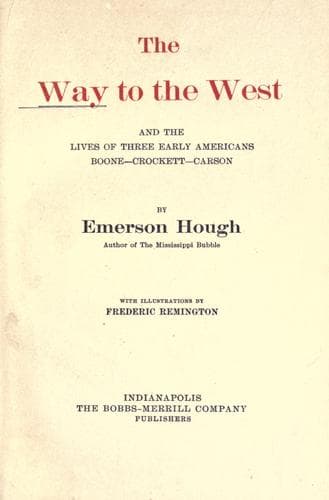
The Way to the West, and the Lives of Three Early Americans: Boone—Crockett—CarsonHough, Emerson
History
The Way to the West, and the Lives of Three Early Americans: Boone—Crockett—Carson
Hough, Emerson
Boone, Daniel, 1734-1820; Carson Kit, 1809-1868; Crockett, Davy, 1786-1836; Mississippi River Valley -- History; West (U.S.) -- History
Discovering that, ten years before Jedediah Smith made his journey
northward across Oregon to Fort Vancouver, there were well established
lines of travel and well established settlements on the Columbia and its
tributaries, we may think that by this time we are close to the first of
things in Western history. Of course we know that ahead of the Astoria
party was the Lewis and Clark expedition. Before Lewis and Clark came
the Louisiana Purchase, which offered us this territory for exploration;
and the Lewis and Clark expedition will serve as the starting point of
our scheme of the history of the trans-Missouri.
We may, perhaps, reinforce these salient points in memory if we go back
once more well upon this side of our former starting point, and work to
it again upon slightly different lines. For instance, we may ask, who
built Fort Henry, the fort that the Astorians found abandoned, west of
the Rocky Mountains? The answer is, Major Andrew Henry, some time
partner of that energetic early merchant, General Ashley. Henry was at
the Three Forks of the Missouri in 1810. He crossed southward through
the mountains and built Fort Henry in the fall of that year. This was
the first post built west of the Continental Divide. It was erected on
what is now known as the Henry Fork of the Snake River.
But was Major Henry himself the first man to penetrate into the Rockies?
He was not. Who, then, was ahead of Henry? The answer is, Manuel Liza,
that strange character of Spanish, French and American blood, who was
perhaps the first of the Western merchants to catch the full
significance of the Lewis and Clark expedition. We have heard of one
William Morrison, of Kaskaskia, Illinois, who sent a representative to
far-off Santa Fé. This same William Morrison was the partner of our
strange genius, Manuel Liza, in the first fur trading venture up the
Missouri. They fitted out one keel-boat for the Northwest trade in the
spring of 1807.
Did Liza and his hardy crew of keel boatmen find an untracked and
uninhabited wilderness? Not altogether such; for, as they were ascending
the ancient waterway, they met coming down one John Colter, that hardy
soul who had left the Lewis and Clark expedition to return to the
Yellowstone River for the purpose of doing a little beaver trapping on
his own account. Colter, it may be remembered, is thought to have been
the first discoverer of the region now included in the Yellowstone
National Park. This country was discovered and forgotten, to be later
officially “discovered” on the same basis that Frémont discovered other
portions of the Rockies. Colter is the last link in this chain. He
brings us back again to Lewis and Clark, the first of the up-stream
adventurers to penetrate the region of the trans-Missouri.
Public-domain text, read in full here on John Shaqi.
Reviews
Reviews
No reviews yet
Be the first to share your thoughts on this work.
Elsewhere in the archive
Join the Discussion
Join the discussion
Sign in to leave a comment or review.
Sign InorCreate an account