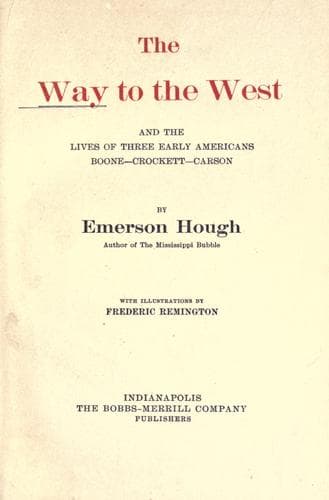
The Way to the West, and the Lives of Three Early Americans: Boone—Crockett—CarsonHough, Emerson
History
The Way to the West, and the Lives of Three Early Americans: Boone—Crockett—Carson
Hough, Emerson
Boone, Daniel, 1734-1820; Carson Kit, 1809-1868; Crockett, Davy, 1786-1836; Mississippi River Valley -- History; West (U.S.) -- History
There were sixty-four of these Astorians, and they had with them
eighty-two horses. They must have passed to the north of the Black
Hills. They crossed the Big Horns and on September twenty-ninth were on
the Wind River, a stream later to be so well known by trappers and
traders. They ascended the Wind River about eighty miles, seeking for a
place to cross the Rocky Mountains. They had Crow Indians as guides
through the Big Horns, and west of the Big Horns the Shoshones had
guided them. These Indians detected signs of other Indians on ahead, and
hence did not present to these travelers the natural and easy way,
through the South Pass,—an ascent so gentle that one can scarcely tell
when he has reached the actual summit. The Astorians crossed the
mountains probably at what is now known as the Union Pass, a little to
the north of the South Pass.
On September twenty-fourth they started from the Green River to the
Snake River, and on October eighth, 1811, reached Fort Henry, which, at
the time the Astorians reached it, was an abandoned post. It seems that
even these early travelers found a West in which there had been some one
before them! Thence, scattered and disorganized, on foot and by boat,
this party undertook to go down the Snake River to the Columbia. By
January first, 1812, they reached the valley known as the Grande Ronde.
By January eighth some of them were on the Umatilla River, and some of
them reached the Columbia by January twenty-first. Here they met
Indians, who told them of the destruction of the Tonquin and the loss of
a great number of their associates—an incident that shows well enough
the strange fashion in which news travels in the wilderness.
Some parties under Mackenzie, McLellan and Reed separated, came down the
Clearwater to the Lewis or Snake River, and thence voyaged on
down-stream as best they could. Some of these reached Astoria January
eighteenth, 1812, ahead of others of their scattered companions, who
seem to have wandered aimlessly about the upper tributaries of the
Columbia. The party under Hunt reached Astoria February fifteenth, 1812.
Crooks and Day, others of the expedition, did not come in until May
eleventh. A party of thirteen trappers, who had been left behind to
pursue their calling, did not reach the post until January fifteenth,
1813. The trip, measuring by the time of the first arrivals at the mouth
of the Columbia, had required three hundred and forty days. Thirty-five
hundred miles of country had been covered. The Northwestern Company had
been beaten in the race to the mouth of the Columbia by just three
months. It was beaten by a gait of about ten miles a day! We build
railroads almost as rapidly as that to-day.
Public-domain text, read in full here on John Shaqi.
Reviews
Reviews
No reviews yet
Be the first to share your thoughts on this work.
Elsewhere in the archive
Join the Discussion
Join the discussion
Sign in to leave a comment or review.
Sign InorCreate an account