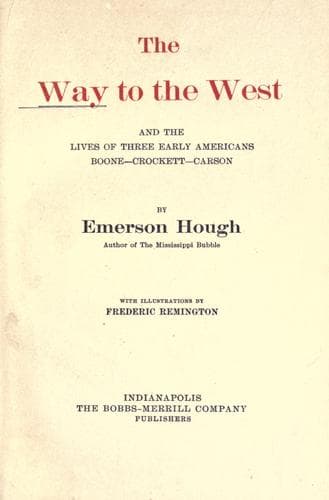
The Way to the West, and the Lives of Three Early Americans: Boone—Crockett—CarsonHough, Emerson
History
The Way to the West, and the Lives of Three Early Americans: Boone—Crockett—Carson
Hough, Emerson
Boone, Daniel, 1734-1820; Carson Kit, 1809-1868; Crockett, Davy, 1786-1836; Mississippi River Valley -- History; West (U.S.) -- History
Thus, if we begin to study too closely into the early history of the
trans-Missouri, we begin to lose all respect for its mysteries, and come
to think of it as a country that was never new, but was always well
known. Indeed, there is much warrant for this. Witness again the
journeys of that straightforward character, Lieutenant Pike, the first
American officer to reach the headwaters of the Mississippi River, and
to arrange for the proper respect for the American flag in that far-off
country. After Pike had returned down the Mississippi River and had been
ordered to explore the country near the Rockies, around the headwaters
of the Red River, he began to cross the trails of some of these earlier
adventurers of whom we have been speaking. Thus, in 1806, while Pike is
making his way across the plains, he hears of Lewis and Clark’s descent
of the Missouri. On August nineteenth, 1806, he states that he finds the
“place where Mr. Chouteau formerly had his fort.” Chouteau was one of
these same early fur traders, as we shall find if we care to go into the
minutiæ of history. Lieutenant Pike describes this fort as “already
overgrown with vegetation;” so it could not have been new in 1806.
From this point Lieutenant Pike goes to “Manuel Liza’s fort,” which then
marked another advance post of the trans-Missouri travel. Next he heads
westward, touches the Grand and White rivers and reaches the Solomon
Fork. Here he meets the Pawnees, discovers that they are wearing Spanish
medals, learns that the Spaniards have sent an expedition into that
country from the New Mexican settlements, and finds a “very large road”
over which the Spaniards have returned to the westward. Thus it seems
that not even good Zebulon was to have a West all his own.
Forsooth, Lieutenant Pike might have gone back more than two hundred
years, and have bethought himself of the old Spaniard Coronado, who in
the year 1540 journeyed from Mexico across the plains until he stood on
the banks of the Missouri River, from which Pike himself started forth.
And strange enough, if we seek for coincidences, is the fact that
Coronado himself recounts that he met on the Missouri River, that is to
say, on the stream that is now called the Missouri, an Indian who wore a
silver medal that was evidently the work of a white man. There is
something singular for you, if you seek a strange incident! Where did
Coronado’s Indian get his medal? This was closer to the first of things.
It must have come from the settlements of the whites on the lower
Atlantic slope. But by what process of travel? Are we indeed to have any
mysteries in the West, and shall we ever be able to set any date in our
scheme of transportation properly to be called initial?
Public-domain text, read in full here on John Shaqi.
Reviews
Reviews
No reviews yet
Be the first to share your thoughts on this work.
Elsewhere in the archive
Join the Discussion
Join the discussion
Sign in to leave a comment or review.
Sign InorCreate an account