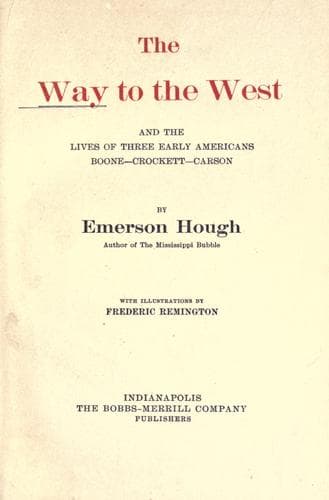
The Way to the West, and the Lives of Three Early Americans: Boone—Crockett—CarsonHough, Emerson
History
The Way to the West, and the Lives of Three Early Americans: Boone—Crockett—Carson
Hough, Emerson
Boone, Daniel, 1734-1820; Carson Kit, 1809-1868; Crockett, Davy, 1786-1836; Mississippi River Valley -- History; West (U.S.) -- History
If we look at a map of the trans-Missouri as it existed in 1840, prior
to the official exploration of the West, we shall indeed find that
“hardly one of the great geographical features was unknown.” We shall
find the Missouri and the Yellowstone rivers dotted thick with the
stockades of the fur traders. We shall find, if we search in the records
of those days, that the whites had long lived among the Indians and had
come to know their ways. We shall discover, if we care to believe such
apochryphal history as that offered by the ostensible Indian captive,
John D. Hunter,[46] that the Indian himself has been something of an
explorer. Hunter tells of plains Indians, dwellers of the prairie
country near the Missouri, who themselves made the transcontinental
journey and saw the mouth of the Columbia. He states that this journey
was traditional at that time, and adds that he himself, with a party of
plains Indians, likewise made this journey to the Columbia, crossing the
Rockies at a different pass in coming back from that met with in the
western journey.
We may believe his story or not, as we like; but we are bound to believe
that these plains Indians antedated the first white men in the discovery
of the South Pass and of many other features of the Rocky Mountains. It
is doubtful, indeed, whether any party of white men in those early days
ever crossed the mountains excepting under the entire or partial
guidance of Indians, who took them over country known to themselves.
We may believe, therefore, that the native Indian savages furnished the
source of original knowledge to our first explorers. If you be familiar
with the Rockies of to-day, you shall now and again see the old Indian
trails, overgrown and unused, sinking back into the earth. In the valley
of the Two Medicine, on the reservation of those same Blackfeet who once
fought the trappers so boldly, the writer once found, high up on the
mountain side, a plainly traceable trail that led down to the summit of
a high ridge, whence one could look far to the eastward, to where the
Sweet Grass hills loomed out of the level sweep of the prairies. There
was a hunter with me, a man married among the Blackfeet, of whom I asked
regarding this trail. “It is the old Kootenai trail,” said he; “and if
you follow this back to the West, it will take you through a pass of the
Rockies and into the country of the Flatheads.”
Public-domain text, read in full here on John Shaqi.
Reviews
Reviews
No reviews yet
Be the first to share your thoughts on this work.
Elsewhere in the archive
Join the Discussion
Join the discussion
Sign in to leave a comment or review.
Sign InorCreate an account