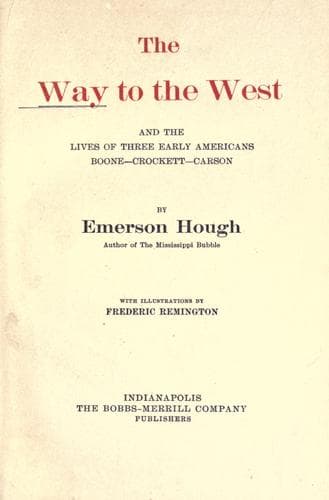
The Way to the West, and the Lives of Three Early Americans: Boone—Crockett—CarsonHough, Emerson
History
The Way to the West, and the Lives of Three Early Americans: Boone—Crockett—Carson
Hough, Emerson
Boone, Daniel, 1734-1820; Carson Kit, 1809-1868; Crockett, Davy, 1786-1836; Mississippi River Valley -- History; West (U.S.) -- History
Within two months in the year 1899, fifty-seven thousand foreigners were
brought to this country to be made over into Americans. Among these were
Croatians, Slavs, Armenians, Bohemians, Servians, Montenegrins,
Dalmatians, Bosnians, Herzegovinians, Moravians, Lithuanians, Magyars,
Jews, Syrians, Turks, Slovaks, with others of the better-known
nationalities, such as English, Germans, French, and Scandinavians. Of
the total number of these immigrants, less than one-tenth had a capital
as great as thirty dollars with which to begin life in the new land.
Many of these immigrants from lower Europe linger in the cities of the
West, and do not become a part of the agricultural communities; but the
indirect tax on the agricultural communities none the less remains. They
become only parasites upon the parasitic middlemen, and all these must
be supported by the farms.
It must be conceded that the new problems assigned to the West in the
way of absorption and assimilation of alien population in these days of
rapid transportation are nothing short of serious and perplexing. These
new people, brought out in swarms by means of the rapid wheels of
steam-locomotion, are like the early Americans who settled first a real
America. They are very poor; their fare must be coarse, their garb mean,
their opportunities for self-improvement but meager. Yet how different
are they, the product of the third age of transportation, from those
Argonauts, the Southern riflemen and the Northern axmen, who toiled with
oar or slow-moving wheel across this land in the days so recently gone
by!
There are three great pictures of the West—one that was, one that is,
and one that might have been. This last picture is a sad one to any
thinking man not concerned in politics. The West of steam-transportation
has not so much impressed itself, and in reason could not be expected so
to impress itself, upon its population as did that West reached by
slow-moving wheels when the natural difficulties to be overcome were so
vastly greater for the individual. The old West begot character, grew
mighty individuals, because such were its soil and sky and air, its
mountains, its streams, its long and devious trails, its constant
stimulus and challenge.
That which was to be has been. The days of the adventurers are gone.
There are no longer any Voices to summon heroes out on voyage of mystic
conquest. It now costs not so much heroism, but so much money, to get
out into the West, and it costs so much to live there. As a region the
West offers few special opportunities. It is no longer a poor man’s
country, nor is any part of America a country good for a poor man. It is
all much alike. Our young men of the West are as apt to go East to seek
their fortunes as to try them near at home. There is no land of the
free. America is not American. Food must digest before it can be flesh
and blood, and our population must digest before it can be called
American.
Public-domain text, read in full here on John Shaqi.
Reviews
Reviews
No reviews yet
Be the first to share your thoughts on this work.
Elsewhere in the archive
Join the Discussion
Join the discussion
Sign in to leave a comment or review.
Sign InorCreate an account