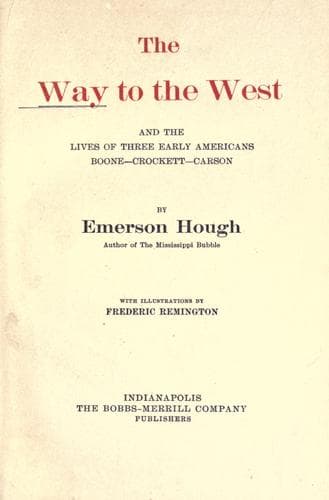
The Way to the West, and the Lives of Three Early Americans: Boone—Crockett—CarsonHough, Emerson
History
The Way to the West, and the Lives of Three Early Americans: Boone—Crockett—Carson
Hough, Emerson
Boone, Daniel, 1734-1820; Carson Kit, 1809-1868; Crockett, Davy, 1786-1836; Mississippi River Valley -- History; West (U.S.) -- History
As once the West had sought to secede, now at length the South,
foster-mother of the West, bethought herself to set up a separate land,
even at the very time when there was in progress a great
transcontinental project that was to make all this country one, forever
and inseparable. It was the Civil War that delayed the construction of
the Pacific railway. Had that road been built, had the roads from the
North into the South been built half a generation earlier, there could
never have been any Civil War. The indissoluble brotherhood of the North
and the South would have been established a generation before, and at
what untold saving of splendid human life! This war, fatally and
fatefully early—early by a quarter of a century, since after that
quarter-century it could never have attained importance, or could never
have been at all—changed history in America more than any written
history has ever shown. Still curiously and intimately connected, it was
the South and the West that were to suffer most in that war, cruel as
this may sound to that splendid East that poured its blood like water
and its treasure with a freedom the West might not equal.
The industrial revolution of the West was subsequent to the Civil War,
and was, to large extent, caused by the Civil War, or, rather, was
dependent upon the same conditions that had part in bringing forth that
war. The vast and virgin West, “confessedly but little known,” lay
waiting for a population. The Eastern portion of the Northern States had
its own population. The South, under the conditions of that day, offered
incalculably more opportunity for crude labor than did the West; but it
offered no security for either capital or labor. Therefore it was that
the Old World was called upon to furnish the raw labor requisite to
subdue this wild land.
It can be only with horror that we reflect that the Old World was called
upon also to furnish us a people to replace the more than half-million
dead of as grand a population as the world ever knew, the flower of
America, North, South, East, and West. It would have been this splendid
army of men that would have settled the West, had it not been for the
war, which a few years later would have been an impossible thing. Could
that half-million dead have arisen from the grave in the decade
following that truly cruel war, the nomenclature of many Western cities
would be different to-day, and the face of the census maps would show a
different story. To-day the whole upper portion of the population chart
of the United States is black with the indication of a foreign-born
population. The only part of this country that the census map dares call
American is a thin, wavering line along the plateaus of Tennessee and
Kentucky,—the land that the first adventurers sought out when they
crossed the Alleghanies. It is the South alone that is to-day American.
It was the South that gave us the new-American, that splendid figure in
the history of the world.
Public-domain text, read in full here on John Shaqi.
Reviews
Reviews
No reviews yet
Be the first to share your thoughts on this work.
Elsewhere in the archive
Join the Discussion
Join the discussion
Sign in to leave a comment or review.
Sign InorCreate an account