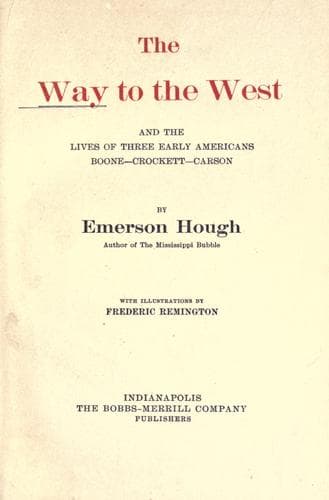
The Way to the West, and the Lives of Three Early Americans: Boone—Crockett—CarsonHough, Emerson
History
The Way to the West, and the Lives of Three Early Americans: Boone—Crockett—Carson
Hough, Emerson
Boone, Daniel, 1734-1820; Carson Kit, 1809-1868; Crockett, Davy, 1786-1836; Mississippi River Valley -- History; West (U.S.) -- History
Augur of what might have been, but for our Civil War, was that long line
of white-topped wagons that streamed westward across Illinois, Iowa,
across the Missouri River, out into the West, the still glorious and
alluring West, immediately upon the close of the war. This was not an
influx of foreigners, but a hejira of native Americans, a flood-tide
that could not wait for the railroads that were now so swiftly taking up
the new and mighty problems of a convalescent country. “By an impulse,
providential or evolutionary, but irresistible,” said an American
statesman of that decade,[55] “civilization has, during the present
generation, moved all at once and in concert, in a process of
territorial expansion as sudden and inexplicable as that which at the
close of the fifteenth century impelled the nations of Europe to voyages
which, resulted in the discovery and occupation of America. . . . The
United States will command the greatest part of the trade with the
Chinese Orient. We can produce every article that can be sold in this
now and limitless market.” Not bad reiteration, this, of the prophecy of
our historian of 1855. The latter did not foresee our Civil War, nor
could he have foreseen our armies across seas. They are there not so
much by reason of political mistakes or political wisdom as by an
impulse “providential or evolutionary.” In 1865, upon the plains, or in
1900, in the Asian islands, the army was only the escort. It is not our
army that will conquer new provinces and create new opportunities in
place of those with which we have been so sadly careless and so lavishly
generous; it is our railways and our steamships that are to prove our
conquering agencies. Thereby we shall recoup ourselves at the coffers of
the world.
We lose all sentimental regrets and superficial reservations when we
come to examine closely the tremendous revolutions created by the genius
of modern transportation. With the era of steam came a complete reversal
of all earlier methods. For nearly a century following the Revolutionary
War the new lands of America had waited upon the transportation. Now the
transportation facilities were to overleap history and to run in advance
of progress itself. The railroad was not to depend upon the land, but
the land upon the railroad. It was strong faith in the future
civilization that enabled capitalists to build one connected line of
iron from Oregon down the Pacific coast, thence east of the mouth of the
Father of Waters, in all over thirty-two hundred miles of rail. Then
came that daring flight of the Santa Fé across the seas of sand, a
venture derided as folly and recklessness.
Public-domain text, read in full here on John Shaqi.
Reviews
Reviews
No reviews yet
Be the first to share your thoughts on this work.
Elsewhere in the archive
Join the Discussion
Join the discussion
Sign in to leave a comment or review.
Sign InorCreate an account