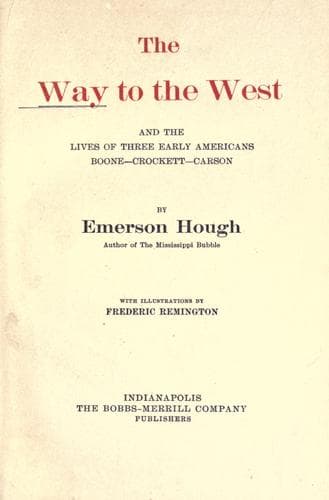
The Way to the West, and the Lives of Three Early Americans: Boone—Crockett—CarsonHough, Emerson
History
The Way to the West, and the Lives of Three Early Americans: Boone—Crockett—Carson
Hough, Emerson
Boone, Daniel, 1734-1820; Carson Kit, 1809-1868; Crockett, Davy, 1786-1836; Mississippi River Valley -- History; West (U.S.) -- History
The proof you may find by seeing the cities that have grown, the fields
which bear them tribute. North and south, and east and west the prairie
roads run. The long trail of the cattle-drive is gone, and the cattle no
longer walk a thousand miles to pasture or to market. Once, twice,
thrice, the continent was spanned, the dream of Robertson made
manifoldly true, and the path across the continent laid well and laid
forever.[56] In the Middle West the Great American Desert was
cross-hatched with iron lines and dotted full with homes that never
could have been but for those iron lines. In the Northwest lay a land of
almost arctic winters, with little or no shelter, with short and torrid
summers, the land of the Red River carts, where the fur traders were at
last replaced by the raisers of number two hard wheat.
Into this region came a large foreign population, sought out in the Old
World by the diligent agents of a common carrier needing business. The
hard plains of the North were literally stocked with these people. They
came with their tickets bought through to such or such a point in
Minnesota or Dakota. It was foreseen that the mere raising of wheat
could not build up a permanent civilization, and the railway did the
thinking for the blind ones who had taken its word and risked their
lives and fortunes in the removal to that America which had so wide and
various an interpretation. The railway sent out, free and unsolicited,
seed wheat and choice breeding-stock, dropping these contributions
wisely, here and there, into such communities as most needed them. The
railway was explorer, carrier, provider, thinker, heart, soul, and
intellect for this population that in another generation was to be
American. No wonder these folk stand and stare when the railway-train
goes by. It has been Providence to them. It is a Providence that has
given to Europe what America might have had.
To-day towns do not grow merely because of their location, and this
factor of location will become less and less important as the years go
by. St. Louis was a city of location; Chicago is a city of
transportation. Chicago is situated upon the most impossible and
unlovely of all places of human habitation. She is simply a city of
transportation, and is no better than her rails and boats, though by her
rails and boats she lives in every Western state and territory. The same
is true now of St. Louis and the vast Southwest.
Public-domain text, read in full here on John Shaqi.
Reviews
Reviews
No reviews yet
Be the first to share your thoughts on this work.
Elsewhere in the archive
Join the Discussion
Join the discussion
Sign in to leave a comment or review.
Sign InorCreate an account