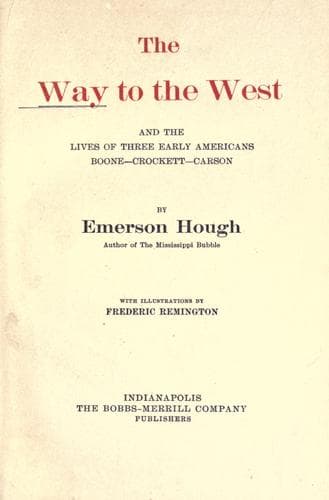
The Way to the West, and the Lives of Three Early Americans: Boone—Crockett—CarsonHough, Emerson
History
The Way to the West, and the Lives of Three Early Americans: Boone—Crockett—Carson
Hough, Emerson
Boone, Daniel, 1734-1820; Carson Kit, 1809-1868; Crockett, Davy, 1786-1836; Mississippi River Valley -- History; West (U.S.) -- History
It all sounds easy, but it took one man’s brain and one man’s life to do
it. The story of the road and of the man that made it is not yet told,
but it will be written in the development of one of the richest sections
of America. It is writing daily in the trains that come from North to
South, from South to North, agencies that daily break down and pass
through any sectional barrier and bring about the better understanding
which makes kin one with the other the sons of the old riflemen and the
old axmen who built the West.
Thus are the trails of the two forever interwoven. Beside this trail of
commerce runs the old trail of the Mississippi, whose tawny flood still
carries its burden of adventure and romance. Robertson, Thomas, Whitney,
Osborn,—these are the names of a few of the prophets, forgotten men of
the early and the modern days, who blazed the intercurrent trails where
now march the feet of those living under a complex civilization.
From these crude studies of early Western history we may gather one very
significant fact, which will mean more a hundred years from now than it
does to-day. It is that America got her territory first, and then her
transportation and her population. She bought on a rising market, and
her purchase was of territory, land, the only thing on earth that can
not be increased or multiplied. Moreover, her land was such as the earth
has never duplicated and can never duplicate. The magnificent American
West was a realm unrivaled, and it was originally settled by men who had
the most priceless of all possessions, a splendid ancestry. Providence
held back the wheels for a hundred years while the Western character was
forming.
Let us, even though by dint of effort, fling away the personal plaint.
It is un-American to snivel, and as the old-time Western men would not
have done so, neither shall we. The West is not dead. It is immortal. We
have come upon a century of force. The conflict is to be the bitterest
the world has ever known; not the conflict of man with beast, or with
savage nature, but the conflict of masses of men, masses of things, one
combination against another, one wedge of impact, head on, against
another. It is too late to call out for an America like that of
Washington or Jefferson; too late to ask for a practical Monroe
doctrine; too late to speak of policies or politics gone by.
Public-domain text, read in full here on John Shaqi.
Reviews
Reviews
No reviews yet
Be the first to share your thoughts on this work.
Elsewhere in the archive
Join the Discussion
Join the discussion
Sign in to leave a comment or review.
Sign InorCreate an account