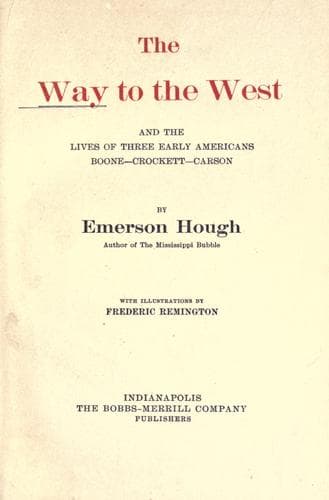
The Way to the West, and the Lives of Three Early Americans: Boone—Crockett—CarsonHough, Emerson
History
The Way to the West, and the Lives of Three Early Americans: Boone—Crockett—Carson
Hough, Emerson
Boone, Daniel, 1734-1820; Carson Kit, 1809-1868; Crockett, Davy, 1786-1836; Mississippi River Valley -- History; West (U.S.) -- History
The original lines of this road were laid out in the form of a large Y,
one leg of which ran from Dubuque, Iowa, southward, meeting the other
leg, which extended south from Chicago. The two legs of the Y met at
what is now Central City, and thence the line ran south to Cairo. This
road was one of the earliest attempts to parallel the old water-highways
that had once carried the freight of a riparian population. Its first
grant was made in 1850, and its first train was run in 1855. During the
war this line was of much service in transporting troops and material to
the southward.
Yet, in spite of its well-conceived plan, and in spite of the natural
wealth of the country it traversed, the road as a property was a source
of perpetual anxiety to its shareholders. It needed a great mind to
straighten out its problems, and Mr. Sturges thought that his son-in-law
had that mind. He therefore despatched Mr. Osborn to Chicago, and gave
him full charge of the system. The choice was a wise one. Mr. Osborn
brought the property through the panic of 1857, when all securities were
falling in ruins, and weathered even an assignment, which was made by
the company during his absence in England. He backed his faith in his
judgment by negotiating a personal loan of three million dollars, out of
which he paid the matured coupons that were pressing for payment. He
secured a new loan of five million dollars, paid off all the smaller
debts, established the credit of the company, and set its affairs
thenceforth upon a secure footing.
All these details were such as might perhaps have been accomplished by
another. It was not only in these executive matters that the genius of
this captain evinced itself. He saw at once to the marrow of the
difficulties that had caused this embarrassment. There had now been
built around the foot of Lake Michigan those east-and-west through lines
that killed the lake carriage just as his own road had killed the river
carriage on the Mississippi trail. These roads reached out after their
own business, and did not depend upon the traffic the north-and-south
line carried. It was easy to foresee a failing business, but not so easy
to name a remedy for it. Mr. Osborn found his remedy in the idea of a
north-and-south transcontinental line. Between Cairo and the town of
Jackson, Tennessee, there was a gap over which no railroad passed,
though from Jackson as far south as New Orleans there ran the rambling
lines of a system controlled by H. S. McComb, of Crédit Mobilier fame.
Mr. Osborn secured the immature Southern roads, built the connection
from Cairo to Jackson, and in 1873 had a completed line from the Lakes
to the Gulf.
Public-domain text, read in full here on John Shaqi.
Reviews
Reviews
No reviews yet
Be the first to share your thoughts on this work.
Elsewhere in the archive
Join the Discussion
Join the discussion
Sign in to leave a comment or review.
Sign InorCreate an account