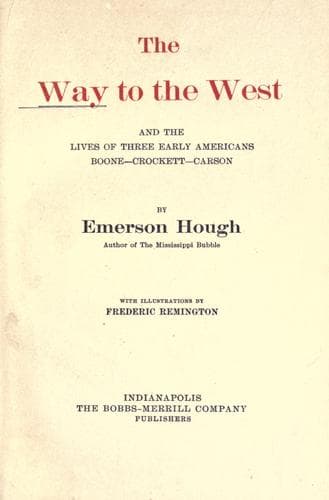
The Way to the West, and the Lives of Three Early Americans: Boone—Crockett—CarsonHough, Emerson
History
The Way to the West, and the Lives of Three Early Americans: Boone—Crockett—Carson
Hough, Emerson
Boone, Daniel, 1734-1820; Carson Kit, 1809-1868; Crockett, Davy, 1786-1836; Mississippi River Valley -- History; West (U.S.) -- History
As to the future steps in the development of the West, we may perhaps be
indulged in a hazard of opinion, as our fathers were before us. It would
seem sure that every inch of our agricultural lands must come under the
plow of Belgium, and be tilled inch by inch. The vast Delta of the
Mississippi, from Memphis south, the richest soil the world ever saw,
will be a continuous garden, supporting a great population of its own,
and feeding thousands in the cities, in full verification of the wisdom
of the man who foresaw that the South must be joined to the North, even
as the West to the East. Perhaps some of the more barren steppe country
of the West will ultimately be abandoned in spite of scientific
irrigation, just as some of the slashed-off timber-lands of Michigan,
Wisconsin and Minnesota are now being abandoned, in sequel to the
ruinous American lumbering operations.[58]
In the great river valleys there will be an enormous thickening of the
population; so that it may yet be many years before the center of
population, which in 1900 was near the little town of Columbus, Indiana,
shall have passed the Mississippi River in its west-bound course.[59] We
have yet to learn to save our potato-peelings. We are yet to go more and
more under task-masters, are to learn more and more the value of the
penny, that coin once so bitterly scorned in all the West. We are to
work out the problems bequeathed humanity with the passing years; and in
the end we are to ask, as we ask to-day, that unanswered question, Why?
Policies and politics can not change these things. The wheels have run
too far. Let fall the little words of our talking men; let wave the tiny
swords of those who are called our warriors; and let the writers rage.
Back and beyond their trivial and transient deeds runs the broad, somber
flood of fate. Humanity, not political divisions, is the concern of
time. The individual yields to the section, the section to the nation,
the nation to the world, the world to the plans of fate, of Providence.
There is another, a lighter and more cheerful side to the conclusions
that we may draw from our study of the way in which the West was
made—the side that has to do with the growth of the newer portions of
this country in all the liberal arts, in that noble flowering of the
human imagination, which is most naturally to be expected of an
environment of ease and a time of leisure. Art rests ever upon the
material, the imagination dates ever back to actual deeds. The gentler
days of the West are no better than its ruder times, but the one is as
good as the other, since each came in its proper period. It was the
railway that developed the West in artistic things as well as in
material things. It was as long ago as 1870 that a Western man, Justice
Paine of the Wisconsin Supreme Court, found occasion to speak of the
vast influence of these civilizing agencies. He said:
Public-domain text, read in full here on John Shaqi.
Reviews
Reviews
No reviews yet
Be the first to share your thoughts on this work.
Elsewhere in the archive
Join the Discussion
Join the discussion
Sign in to leave a comment or review.
Sign InorCreate an account